Article

New AGS Members in 2021

- by
Tags: Featured

The AGS is pleased to announce that in 2021, nine member organisations, one affiliate organisation and three practitioner members were accepted by the Membership Panel and approved by the Executive. Six students and graduates were also accepted as AGS members. The new member organisations are Exploration and Testing Associates Ltd, GE Solutions Consulting Ltd, Orsted A/S, Sweco UK, Brownfield Solutions Ltd, Omnia Environmental Consulting, Eurofins Chemtest Ltd, London Bridge Associates and WDE Consulting Ltd. The new affiliate organisation is The CDS Group and the new practitioner members are Tim Rolfe, Janice Windle and Neil Chadwick.

AGS Membership is open to geotechnical and geoenvironmental companies who employ specialists who can provide competent services and affiliate companies who provide support services and supplies to the members. Students and Graduates can also become members of the AGS. Full details of membership criteria can be found at http://www.ags.org.uk/about/become-a-member/

Article

Sustainable Management Practices

- by
Tags: Featured

SuRF UK have recently published updated guidance on Sustainable Management Practices (SMP’s) which include 15 sustainable management practices posters.

The SMP’s are “relatively simple, common sense actions that can be implemented at any stage in a land contamination management project to improve its environmental, social and/or economic performance”. ‘SMPs can be used to improve the benefits (e.g. resource efficiency, community satisfaction) or reduce the negative impacts (e.g. spillages, complaints, cost) of a project, leading to project ‘sustainability gains’, without requiring a formal sustainability assessment’. The SMP document describes a simple process to encourage sustainable thinking, decision making and action across all land contamination management activities by using SMPs’. The process could also be applied to geotechnical projects.

The posters include topics such as ‘Set project milestones to ensure periodic review and optimisation of activities’, ‘minimise vehicle miles’ and ‘don’t allow plant and equipment to run for no purpose’.  These posters could be used in a variety of ways to encourage sustainable thinking, for example:

  • As a suitable ‘Sustainability Moment’ in a meeting;
  • As a slide in a presentation
  • At project commencement
  • As an aid in a site briefing

The document and posters can be accessed at the following link: https://www.claire.co.uk/projects-and-initiatives/surf-uk/21-executing-sustainable-remediation/84-sustainable-management-practices

News

AGS Magazine – October / November 2021

- by
Tags: Featured

The Association of Geotechnical and Geoenvironmental Specialists are pleased to announce the October / November 2021 issue of their publication; AGS Magazine. To view the magazine click here.

This free, publication focuses on geotechnics, engineering geology and geoenvironmental engineering as well as the work and achievements of the AGS.

There are a number of excellent articles in this issue including;

AGS Annual Conference Review – Page 4
New AGS Data Validator: Beta – Page 7
Climate Change and Land Contamination Risk Management – Page 12
What is a pragmatic and safe approach to assessing the feasibility and design of infiltration systems on a site? – Page 14
Training Paths for Ground Practitioners – Page 18

Plus much, much more!

Advertising opportunities are available within future issues of the publication. To view rates and opportunities please view our media pack by clicking HERE.

If you have a news story, article, case study or event which you’d like to tell our editorial team about please email ags@ags.org.uk. Articles should act as opinion pieces and not directly advertise a company. Please note that the publication of editorial and advertising content is subject to the discretion of the editorial board.

Article

Q&A with Sarah Hey

- by
Tags: Featured

Full Name: Sarah Hey

Job Title: Project Manager (Programme Delivery)

Company: Hydrock

I have 8 years’ experience in ground engineering, specialising in site investigations and contaminated land. I was based in the Midlands for 5 of those years as a geo-environmental consultant before moving to Manchester in 2018 as a senior geo-environmental consultant. During this time, I gained my chartered geologist and scientist status with The Geological Society. As of January 2021, I side stepped into a project manager role within Hydrock’s programme delivery team. I now manage multi-disciplinary projects and have since gained the APM project fundamentals qualification in project management.

What is your background and how did you end up working within the geotechnical industry?

I graduated from the University of Leicester in 2013 with a master’s degree in geology before embarking on my journey as a geo-environmental consultant. Prior to graduation I never considered working within the construction industry as I didn’t really know much about it. However, a friend on my degree course recommended me for an internship with a firm in Burton-upon-Trent, which I started immediately after graduating. During the early stages of my internship, I primarily carried out gas and groundwater monitoring and gradually progressed to a role as a geologist undertaking ground investigations and report writing.

What does a typical day entail?

Being a Project Manager, my job varies greatly day to day and no two days are the same. I manage multiple projects simultaneously, which are all at various stages within the project life cycle, although a lot of my current projects are at the outline/detailed planning application stage. I help coordinate and facilitate our technical teams and will often be attending virtual meetings to discuss progress on a project or to run through the project requirements. I also frequently write and collate fee proposals when tendering for opportunities, as well as coordinating any due diligence work to aid our clients with the purchasing of land for a development.

My role also involves a lot of business development, as I am the main point of contact for our clients, it is important that I build a relationship with existing and new clients either through virtual or face to face meetings, which often involve catching up over a drink or heading out for something to eat.

Within your career to date, what is your greatest achievement?

There have been quite a few, I was over the moon when I got my chartered geologist status but I would say winning the Best Young Brownfield Professional in 2020 has been my greatest achievement to date.

What is your favourite part of your job?

The socialisation and networking both internally and externally. Especially with virtual meetings through the likes of Microsoft Teams, I would say team members are more accessible. Even though I am based at the Manchester office I work on projects across the UK and as a result I engage with the various disciplines and Hydrock offices so it is great getting to know my colleagues. I am also developing and growing my client relationships, which is a new experience for me.

What are the most challenging aspects of your role?

It’s probably not surprising that I’d say, dealing with problems that I have never dealt with before is the most challenging aspect of my job. However, I enjoy problem solving, where you are faced with an issue which makes you sit back and think about it for a while before deciding on the best course of action. However, as I am relatively new to project management, it does mean I am facing new challenges which I have never encountered before. I am also the point of contact between the client and the Hydrock teams so it’s my job to have those difficult conversations when they come up!

If you could do it all over again, would you choose the same career path for yourself? And if not, what would you change?

I would definitely choose the same career path as I love the variety this role provides; I have worked in some amazing places within the UK and have made some friends for life. It’s a small world within this industry so you’re regularly crossing paths with former colleagues and acquaintances. The only thing I would change differently, if I was to do it again, would be to explore international work in the early stages of my career. I have always been intrigued as to what it’s like working abroad both from a fieldwork perspective, especially to examine the geology in other countries, but also working on international projects where the standards are different.

What AGS Working Group(s) are you a member of and what are your current focuses?

I am part of the Business Practice Working Group and the first early career committee member, which I was fortunate to be asked to join after winning the Best Young Brownfield Professional award that was kindly sponsored by the AGS. Our current focuses are to really promote AGS by enhancing our methods of marketing to attract the wider population, so watch this space for some exciting content.

Why do you feel the AGS is important to the industry?

One of the best attributes of the AGS is the user-friendly guidance’s that are readily available online as part of being an AGS member. For early careers in particular I think these are a great starting point to ensure an understanding of the different elements such as how safely and correctly to conduct a ground investigation from the excavation of a trial pit to sampling of soils for geotechnical testing.

Lastly any advice or words of wisdom that would you give someone who is either considering this type of job or who are progressing towards chartership?

The advice I always give to anyone starting in this industry is to log your CPD from the word go. This is pivotal if you are applying for chartership with an organisation such as The Geological Society. It’s much harder to backtrack what you’ve learnt and remember that practically everything counts as CPD when you first start out. The Geological Society have an excellent mind map which demonstrates all the activities that count as CPD and I think this is a good starting point.

Article Geotechnical

Geotechnical Engineering in a Net Zero Carbon World Webinar Summary

- by
Tags: Featured

The AGS webinar on Geotechnical Engineering in a Net Zero Carbon World took place on 6th October. The event was sponsored by Geotechnical & Environmental Associates and WSP.

This webinar saw Dr John Henry Looney (Director, Visiting Fellow and Hon Professor at Sustainable Direction Ltd, University of Bristol and the University of Nottingham), Natalia Fernandez (Associate Director at Ramboll) and Tony Suckling (Director at A-squared Studio Engineers Ltd and A2 Site Investigation Ltd) investigate what targets we need to set, which construction methods and materials provide major sources of embedded carbon, and explore how we can all contribute to a more sustainable approach to investigation, design and construction.

The event also covered why carbon reduction is important, how to reduce emissions by measuring the carbon footprint and how the GI has helped or prevented a more sustainable solution being used.

If you missed this webinar, the replay is now live and available for view on the AGS website for free. Click HERE to view the replay and download the speaker presentations and file handouts.

Article

AGS Annual Conference 2021 – an overview

- by
Tags: Featured

This year’s AGS Annual Conference, returned to the National Motorcycle Museum in Birmingham. The Annual Conference was the first AGS face-to-face event since January 2020. The day was a great success and well attended by 132 delegates.

The presentations covered a range of geotechnical and geoenvironmental topics which were well received. The conference was chaired by AGS Chair, Sally Hudson.

The keynote speaker, Luke Swain of Network Rail presented on the importance of Geo Engineers in the response to the symptoms of a changing climate, including looking at climate change and why Geo Specialists are so critical to the response.

Julian Lovell of Equipe Group provided an update on the Third Edition of The UK Specification for Ground Investigation (Yellow Book) and the major changes involved within the third edition. The third edition is due to be published within the first quarter of 2022. Helen Townend of Amey Consulting gave a presentation on building inclusion, showing how it can appeal to the next generation and the benefits experienced of operating in an inclusive way. Duncan Scott of Vertase FLI provided a presentation on landfill reclamation, looking at landfills in the UK and how old landfills can be reclaimed. Ian Webber of Coffey Geotechnics discussed misuse of monitoring and testing. Ian used case histories to provide details on lessons learnt.

The final talk of the day was provided by Clare Brint of Network Rail, who presented on Earthworks Asset Management at Network Rail (Eastern Region). Clare provided details of how the team operate to fully understand the risks from different hazards and how they mitigate the risks by predicting, preventing and responding.

All the AGS Working Group Leaders delivered updates on what they have been working on over the past year.

Special thanks to this year’s speakers; Sally Hudson (AGS Chair and Coffey Geotechnics), Luke Swain (Principal Route Engineer (Geotech), Network Rail), Julian Lovell (Managing Director, Equipe Group), Helen Townend (Technical Director, Amey Consulting), Duncan Scott (Technical Director, Vertase FLI Ltd), Ian Webber (Manging Director, Coffey Geotechnics Limited) and Clare Brint (Route Engineer, Eastern Region, Network Rail).

Special thanks also to this year’s sponsors and exhibitors.

The speaker presentations can be viewed on the AGS website HERE.

Article Geotechnical

What is a pragmatic and safe approach to assessing the feasibility and design of infiltration systems on a site? When is it appropriate to undertake BRE365 tests, and how can we do so safely?

- by
Tags: Featured

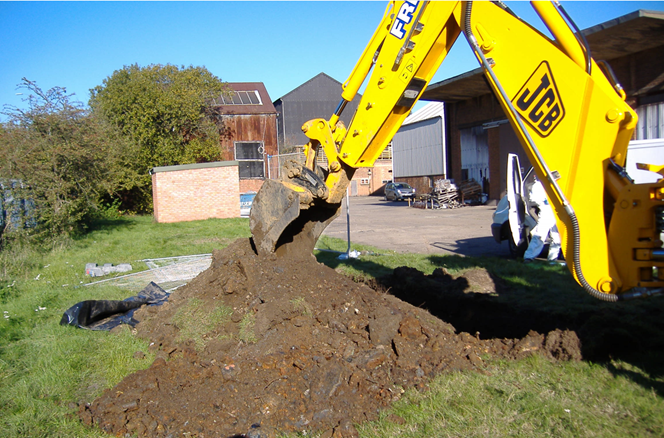
Image credit: James Harrison – 4D GEO LTD

Article by Georgina Donbroski (Technical Director at Leap Environmental Ltd), James Harrison (Director at 4D Geo Limited) and Alex Dent (Associate Director at WSP)

Firstly, with respect to Health and Safety matters, it should be noted that CDM Regulations place duties on both the designer (of the ground investigation, including scheduling soakaway tests) and the contractor who will be implementing the tests. Based on CDM requirements, the following considers the ERIC principle, of Eliminate, Reduce, Improve and Control.

As with any site investigation process, a phased approach makes the most sense.  A good desk study should be able to ascertain the feasibility for infiltration systems to work on site and hence the potential requirement for BRE365 testing.  Consideration must be given not only to the potential infiltration rates achievable, but also the potential for contaminated land and/or groundwater, flood risk, winter (maximum) groundwater levels, designation of the groundwater resource, potential for ground instability etc, any of which may have a significant impact on the feasibility of the use of infiltration based drainage systems.

CIRIA C753 SUDs manual outlines how the above should be considered at the conceptual design stage, and encourages a preliminary assessment using desk based sources.  Assuming no other constraints exist, C753 also gives some preliminary infiltration ratings (good/poor/very poor/other)  based on soil type and notes that where infiltration rates of 10-6m/s of higher are anticipated (clays, clayey ‘loams’, structureless chalks), then an infiltration scheme may not be viable.

Thus we can eliminate (ERIC) unnecessary  testing  at an early design stage. The elimination of unnecessary  testing is clearly desirable, not only in terms of cost savings for the client but also from a Health and Safety point of view, especially when one considers the specific health and safety issues associated with soakaway testing (deep excavation and water).

Assuming the desk study indicates an infiltration based drainage system may be feasible, then is the phase 2 investigation a good time to undertake BRE365 testing?  Possibly not.  Do you know the maximum groundwater level, the detailed scheme layout, final ground levels, proposed location of SUDs?   If not, then perhaps it is still too soon to undertake large scale testing.  C753 states that “groundwater levels should be investigated to ensure the base of the proposed infiltration component is at least 1m above the maximum anticipated groundwater level (taking in to account any seasonal variations in levels and any underlying trends)”, and a greater unsaturated zone may be required by the Environment Agency if your site is located  within a groundwater source protection zone.

It is also critical for detailed design that the BRE365 test undertaken accurately replicates the zone of infiltration proposed for the final design.  An infiltration rate obtained from 2m head of water in a 3m deep trial pit will not provide an appropriate infiltration rate for permeable paving.  Similarly, a 1m shallow soakage test will not provide a suitable infiltration rate for permeable paving design if ground levels are to be significantly reduced.  And finally, particularly for sites where the infiltration potential is borderline and interbedded soil types are predominant, then testing at your proposed infiltration component location will be critical to obtain representative parameters for design.

So what can we do at the Phase 2 stage?  Unless you can prove groundwater at depth, then groundwater monitoring is key, and where groundwater is potentially high, more and more local authorities are insisting on winter monitoring.  We are also at an ideal stage to classify our soils using relatively cheap laboratory classification testing (PIs and PSDs), which will enable us as designers to more accurately estimate potential infiltration rates.  Preliminary testing may also be undertaken in boreholes, but the results should be used with caution, noting the smaller volume of water used, the potential for smearing of the borehole sides, depth tested and the need to still test 3 times.  BRE365 tests can be undertaken at this stage, but the client should be made aware that unless the testing is at the correct depth and location, additional BRE365 test should be required at the detailed design stage.

Having established the site is suitable and the type and specification of your infiltration system, then BRE DG365 sets out the method for obtaining the design soil infiltration rate.  Testing is usually within trial pits, which should be undertaken in accordance with the AGS Guidance on the safe excavation of trial pits.  BRE365 notes the pit should be to the same depth as the proposed soakaway, and 1-3m long and 0.3-1m wide, vertical trimmed sides, square and if necessary, for stability, filled with granular material.  Noting that only pits within clay soils or rock may be stable (even this is not a given), and that clay soils should have been deemed unsuitable during the desk study phase, then arguably most pits will need to have a granular backfill to adhere to the BRE DG365 methodology.

Providing a granular backfill also acts to reduce risk (ERIC)  by: significantly reducing the likelihood of trial pit collapse to the short period it remains open; removing the presence of open water filled pits; and enabling greater ease of measurement of water levels via the slotted pipe installed for monitoring.  It also enables testing to continue safely beyond a single day, removing the potential for open pits on site.

Granular backfill may be delivered to site in large bulk bags of pea shingle, enabling the excavator to easily move these to test locations. The monitoring pipe is placed within the trial pit (end covered with a bulk bag to prevent infilling), and the base of the shingle bag split to pour the gravel directly into the pit.  Above proposed invert level, the pit may be backfilled with arisings and the topsoil and turf re-laid if further testing may be required.  If trial pits are deemed stable when water is added, for example in competent chalk, then the trial pit should be covered to minimise/improve (ERIC) the risk of working next to open water, typically with a Heras fencing panel, prior to testing.  Open pits should secure, not be left unattended for any period of time and must be backfilled immediately once testing is complete.  Testing must only be undertaken by suitably trained and qualified staff, controlled (ERIC) under the Safe Systems of Work  defined in the RAMs.

Like any geotechnical design, parameters obtained from testing must first be used accordingly.  The infiltration rate is an empirical measurement which should be calculated as defined in BRE DG365 (with due regard to the use of gravel).  If it is not possible to carry out a test to the full depth of the pit, the guidance is clear that the results may be calculated based on the time for the fall of water from 75%-25% full of the actual maximum water depth achieved, with a similar correction for internal surface area.  Results should not be extrapolated to empty.  Secondly, the results must not be viewed in isolation, and must be given due consideration with respect to all the other factors known on site.  For example, an infiltration rate c10-4m/s obtained on a site known to be underlain by silty clayey sand or ‘loam’ is indicative of some other factor influencing the local infiltration rate.  Either the ground model is wrong, or some other factor, such as a void, made ground, service trench etc are influencing the result.  Geotechnical design requires experience and training,  and the selection of design parameters is critical to providing a sustainable design, including for SUDs.

So in summary,

  • Just like any aspect of geotechnical design, a phased approach to investigation (comprising desk study, preliminary investigation and detailed investigation) should be standard practice.
  • Just like any other aspect of geotechnical investigation due consideration should be given to Health and Safety issues by all parties.
  • If a GI contractor is proposing to undertake soakaway testing without use of gravel backfill (or if this is unclear) this should be queried with them at tender stage.

When client (or their advisors) are requesting soakway testing, it should be queried as to whether suitable desk study research has been undertaken.  Where this is being driven by a third party and being requested counter to the findings of desk study, for example to prove a negative to a LLFA or local drainage board, they should be reminded of the Health and Safety risks that they are introducing by demanding a test that puts personnel (and perhaps the public) at risk for very little or no technical benefit. Perhaps in this situation, if boreholes are being formed anyway for foundation design purposes, consideration could be given to testing based on BS EN ISO 22282-2:2012 Section 6.1.4 (which is also referred to in the SuDS Manual).

All good construction practice comes from experience and learning from others, including mistakes and near misses.  The authors would be pleased to hear members experience on BRE 365 soakage testing.  Have you had any near misses?  Do you use any alternative methods for assessing infiltration?  Have you had occasion to test infiltration systems and compare with original design parameters?

References

CIRIA Report C753 ‘The SuDS Manual’, CIRIA 2015

BRE DG365 ‘Soakaway Desgin’, BRE, 2016

BS EN ISO 22282-2:2012 ‘Geotechnical Invetigation and Testing – Geohydraulic testing. Part 2: Water Permeability testing in a borehole using open systems’, BSi, 2012

Article Sustainability

Climate Change and Land Contamination Risk Management: A multi-disciplinary crisis management challenge

- by
Tags: Featured

Article provided by Paul Nathanail (GHD), Claire Dickinson (Geo Environmental Matters) and Dr. Tom Henman (RSK Geosciences)

Climate change is causing extreme weather events – more intense precipitation, flooding events, prolonged droughts, extremes of temperature, prolonged periods of high or low temperature, more intense storm events leading to frequent and stronger winds and steeper drops in atmospheric pressure. In their pioneering presentation at the 10th Congress of the International Association for Engineering Geology and the Environment, held in Nottingham, Judith Nathanail and Vanessa Banks (2009) highlighted the effect of climate change on land contamination, among other aspects of engineering geology. These changes will influence the way we manage land contamination and carry out site investigations, risk assessments and design, undertake and verify remediation.

As well as influencing slope stability and rates of soil erosion, these events will affect the ground and hence the risks posed by chemical contaminants in the soil, water, non-aqueous and gaseous phases. The strength, deformability, permeability and durability of ground will change. Prolonged droughts will deepen and widen desiccation cracks in high plasticity soils. More intense precipitation will saturate and weaken ever deeper soils. There will also be effects on the water table. Higher temperatures will increase rates of chemical absorption rates, weathering and biological activity.

Extreme weather events will alter the behaviour of contaminants. Increased volatilisation will result from the higher vapour pressure of volatile organic compounds (VOC) resulting from higher temperatures. Most ground gas related incidents relate to very large falls in atmospheric pressure so their occurrence may increase unless adequately mitigated

Higher temperatures and more precipitation resulting in faster weathering could capture inorganic carbon in carbonate minerals. Increased dissolution could release nutrients stimulating microbial activity such as hydrocarbon degradation.  Heavy metal mobility can increase by acidification as more carbon dioxide dissolves in rainwater.

Remediation works will be disrupted by sudden downpours. Wet, slippery conditions increase wear and tear on tyres and make working conditions more dangerous. Worker and public safety will be threatened by stronger winds picking up hoardings or loose materials and equipment.

Risk assessments, remediation design and choice of construction materials must be resilient to modelled climate scenarios, such as extreme summer and winter temperatures and increased precipitation intensity. The probabilistic UK Climate Projections (UKCP18) are based on a limited number of future greenhouse gas (GHG) emission scenarios. Land contamination professionals will need to ensure that an appropriate range of future GHG emission scenarios have been taken into account.

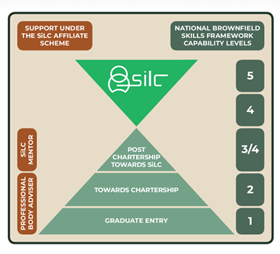
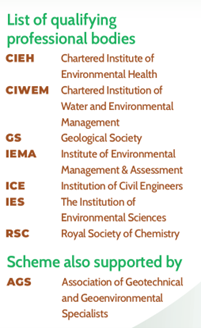
In the UK, a professional is usually identified by being a chartered member of their relevant body. A chartered practitioner has demonstrated a high level of knowledge, skills and experience, and is bound by a strict code of professional conduct.

A SiLC is a senior professional with the broad awareness, knowledge and understanding of land condition to provide impartial advice in the SiLC’s field of expertise. The SiLC Register lists  professionals from the range of professions relevant to land condition matters. SiLC is also the approving body for SQPs able to sign declarations of document adequacy under the National Quality Mark Scheme (NQMS). The Register is managed by the Professional and Technical Panel (PTP) of representatives from relevant professional bodies.

There is always uncertainty within site assessments and considering potential climate change impacts should be as site-specific as possible and based on available regional or local climate projections. The NQMS mandates consideration of uncertainties and the implications for both the site assessment and decisions taken on next steps.

For climate change to be effectively accommodated in land contamination risk management, each profession needs to ensure its insight into the effects of extreme weather effects are considered at each stage of a project. SiLCs are well placed to contribute to such multi-disciplinary assessments and advise on the wider implications for the project.

The authors are members of the SiLC Professional and Technical Panel.  For more information on SILC please visit www.silc.org.uk 

You can also contact Paul via email: paul.nathanail@ghd.com

REFERENCE

Nathanail, J. & Banks, V. 2009 Climate change: implications for engineering geology practice. In: Culshaw, Martin; Reeves, Helen; Jefferson, I; Spink, T.W., (eds.) Engineering geology for tomorrow’s cities. Geological Society of London Engineering Geology Special Publication, pp 65-82, 17pp. Available at: http://nora.nerc.ac.uk/id/eprint/9308/

Report Business Practice

AGS Business Practice Working Group Update

- by
Tags: Featured

Vivien Dent, AGS Chair Elect and Leader of the AGS Business Practice Working Group, has provided an update on the top issues the AGS Business Practice Working Group discussed at their last meeting which took place in September 2021.

New AGS Client Guides

Two new AGS client guides have recently been published on the AGS website which are Client’s Guide to the Selection of Geotechnical Specialists – Geotechnical Engineering / Engineering Geology and Client’s Guide to the Selection of Geoenvironmental Specialists. The client guides can be downloaded here and here.

Training Paths Documents

Two new training paths documents have recently been published on the AGS website which are Training Paths for Ground Practitioners – Geoenvironmental Specialists and

Training Paths for Ground Practitioners – Geotechnical Engineering / Engineering Geology. The training paths documents can be downloaded here and here.

Other Activities

The BPWG are looking at updating the AGS byelaws, collecting data regarding travelling to meetings and conferences in terms of sustainability and producing AGS promotional videos.

We are always keen to welcome new members into the BPWG and so for those interested in the governance of the AGS and wish to know how you can contribute to the BPWG, please contact the AGS Secretariat at ags@ags.org.uk.

Article

Dyslexia Awareness in the Geotechnical & Geoenvironmental Sectors

- by
Tags: Featured

October 4th to 10th was dyslexia awareness week and having a husband and a daughter with dyslexia, I felt prompted to write this article to raise awareness and celebrate the contribution that people with dyslexia make to our industry. This year’s theme is Invisible Dyslexia. Dyslexia itself isn’t visible and is all too often overlooked in the workplace and in education. As a result, people with dyslexia often feel unsupported, unwanted and invisible.

There are many benefits of dyslexia that are desirable to the geotechnical and geoenvironmental engineering sector including spatial visualisation, lateral thinking, deciphering data and creativity. Being able to spatially visualise complex ground conditions is an invaluable skill. Each person’s experience of dyslexia will of course be different, but each will bring skills to your business. If you work with someone with dyslexia, please don’t focus on the miss spelt words -it’s easy for someone else in your team to proof read and spell check. Instead – focus on the technical content and the fact you have a much better report as a result

For anyone wanting to understand a little more about dyslexia or for anyone who need support and advice, I recommend visiting the British Dyslexia Association website.  British Dyslexia Association (bdadyslexia.org.uk) They have a number of services and resources available for people including a helpline and can provide workplace needs assessments. They have a powerpoint designed for a workplace presentation. Link: https://view.officeapps.live.com/op/view.aspx?src=https%3A%2F%2Fcdn.bdadyslexia.org.uk%2Fuploads%2Fdocuments%2FSupport-Us%2F2021-Dyslexia-Week-Workplace-presentation.pptx%3Fv%3D1632413597&wdOrigin=BROWSELINK

Vivien Dent

AGS Chair Elect. Leader of the Business Practice Working Group

News Data Management

New AGS Validator launched by AGS

- by
Tags: Featured

The Data Management committee has been busy again.  Just months after releasing AGS 4.1 we are releasing a beta version of an AGS file validator. The ‘AGS Validator BETA’ is free to download and will provide a single source for validating ‘Electronic Transfer of Geotechnical and Geoenvironmental Data – AGS4’ (AGS Data Format) files.

For many years the industry has used commercial AGS Data Format checking applications (checkers) that sometimes produce differing results due to the varied assumptions made by the developers.  Therefore, clients have traditionally specified AGS files must be validated by several of these checkers before the data is submitted to them, resulting in additional work for clients, contractors, and software providers.

The AGS Validator initiative, started by Asitha Senanayake from Fugro and aided by Roger Chandler from Bentley, has been running for six months and has been rigorously tested by members of the AGS committee over recent months. The committee feel it is ready to be tested in the real world and are therefore releasing it to the industry for beta testing.

The ‘AGS Validator BETA’ is a standalone software program.  There are further initiatives in the pipeline to provide capability to import AGS Data Format files into Excel and the BGS are working on an online web validator due for release at the end of the summer.

All validator Python libraries have been developed under Lesser General Public (LGPL) open-source licences and the AGS would welcome review of the code and further comment.  The project has received coding contributions from four countries to date, demonstrating the power of the collaborative, open-source working environment.

To download the beta software visit:

https://www.ags.org.uk/data-format/ags-validator/

If you have any questions, find any problems or need help with the AGS Validator BETA please complete the feedback form on the website, or if your company are a registered data format user please post your comment on the AGS Discussion Boards at www.ags.org.uk/data-format/dwqa-questions.

The AGS Validator will be in Beta until the Autumn 2021, it must not be specified in contracts until it is fully released later in the year.

Asitha Senanayake, Project Engineer at Fugro –

“I have been using AGS data in my role for several years and have found open-source software to be invaluable for this work. I started this open‑source project to supplement the functionality of the Python Pandas data analysis library to work with AGS data, and I am delighted that the AGS committee has adopted and expanded it”. 

Roger Chandler, Geotechnical Information Management Director at Bentley –

“It is a pleasure to lead this project. Bentley fully supports this venture and will be promoting the use of this AGS Validator instead of our gINT and KeyAGS checkers.  We will be integrating the AGS Validation into OpenGround in the coming months.”

Edd Lewis, Standards Lead, BGS –

“The BGS welcomes this new AGS initiative and fully embraces it to help improve the quality of the AGS Data Format files being submitted to the BGS Depository via our upcoming Web API”.

News

AGS Magazine – August / September 2021

- by
Tags: Featured

The Association of Geotechnical and Geoenvironmental Specialists are pleased to announce the August / September 2021 issue of their publication; AGS Magazine. To view the magazine click here.

This free, publication focuses on geotechnics, engineering geology and geoenvironmental engineering as well as the work and achievements of the AGS.

There are a number of excellent articles in this issue including;

Thoughts from the Chair: Time – Page 8
Missing a trick? – Redeveloping Landfill Sites – Page 18
Taking soil samples for determination of Volatile Organic Compounds (VOCs) – Page 22
Q&A with Stephen Hugh Mallett – Page 26
Inside: SOCOTEC UK – Page 28

Plus much, much more!

Advertising opportunities are available within future issues of the publication. To view rates and opportunities please view our media pack by clicking HERE.

If you have a news story, article, case study or event which you’d like to tell our editorial team about please email ags@ags.org.uk. Articles should act as opinion pieces and not directly advertise a company. Please note that the publication of editorial and advertising content is subject to the discretion of the editorial board.