Article Business Practice

John Talbot; Honorary Life Member of the AGS

- by
Tags: Featured

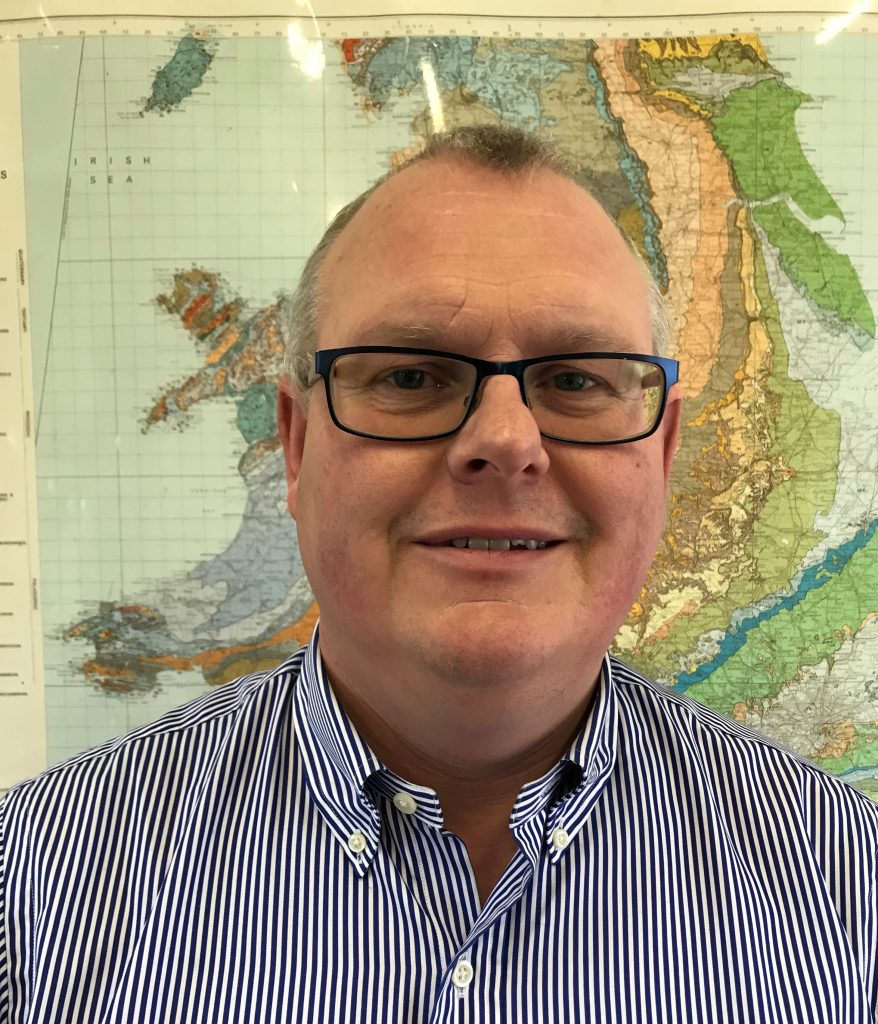
John Talbot, one of the AGS’s longer serving members, is stepping down as Leader of the Business Practice Working Group in April 2018, following 12 years of service to the committee, the last three of which he was its Leader.

Having been a member of the AGS for over 28 years, John has been closely involved for the last 5 years with the updating of AGS governance, which involved producing a huge volume of documents. Here, we look at John’s history within the AGS and some of his contributions and changes he’s helped to make for the industry:

• 2006: became a member of the Business Practice Working Group
• 2011-12: drafted the AGS Code of Business Conduct
• 2013: drafted new Membership Bye-laws, with the assistance of Diane Jennings
• 2013-2014: developed a new and rational model for the AGS annual subscriptions
• 2014: appointed an Honorary Life Member of the AGS in recognition of his sustained contributions to AGS matters
• 2015: drafted the new AGS bye-laws in collaboration with Andrew Milne, which generated;
o the removal of the Executive Committee and the introduction of the AGS Senate in its place 2016
o the introduction of the AGS Executive Council 2016
o new membership categories and production of the associated revised and additional membership application forms 2016
• 2015-2017: drafted the new Articles of Association with Johanna Jennings
• 2015-2018: Chairman/Leader of the Business Practice Working Group
• 2015-2018: revived liaison with AGS Hong Kong
• 2016: drafted the AGS Complaints Procedure
• 2016: instigated registration of AGS for tax relief on members’ subscriptions
• 2016: wrote the Terms of Reference & modus operandi for most of the AGS’ Working Groups, committees and panels, based on the newly instated bye-laws
• 2017: presented with the first Senate Award in recognition of his further contributions to modernising the governance of AGS

We spoke to John before his biannual trip to Hong Kong, when he hopes to be talking to AGS HK, in continuation of our liaison with them, and managed to extract the following snippet:

“I suppose that the greatest challenge during my 12-year membership of the BPWG has been the updating of the Association’s governance. The review of the AGS and its future direction that took place in 2012-15, enabled the production of completely new Bye-laws in collaboration with Andrew Mine. These led to the need to rewrite the Articles of Association (with Johanna Jennings) to ensure that the two documents were mutually aligned.

Sitting quietly, researching and bashing a keyboard to draft these documents, with their concomitant revisions, changes of thought and amendments, was as nothing when compared to the prospect of putting both the Bye-laws and the new Articles to the vote at successive AGMs. All sorts of possible nightmare scenarios were envisaged, of argumentative – even vitriolic – ‘discussions’ that might potentially happen. This impacted adversely not only on those of us who had written the drafts, but on the entire membership of both the Business Practice Working Group and the Executive Committee where a very considerable amount of fingernail biting resulted. However, in the event and to our immense relief, we were given a very easy ride by the AGS Members at the AGMs, when the two governing documents were voted for acceptance, effectively without quibble – huge sighs of relief all round, not to mention profound thanks to the AGM attendees for their positive support!”

John is also the current Vice-President Chartership of the Geological Society and Chair if its Professional Accreditation Chartership Committees. In his ‘spare time’ he is a Director and Trustee of the Wey & Arun Canal Trust, dedicated to restoring a 19th century derelict canal in Surrey and West Sussex.

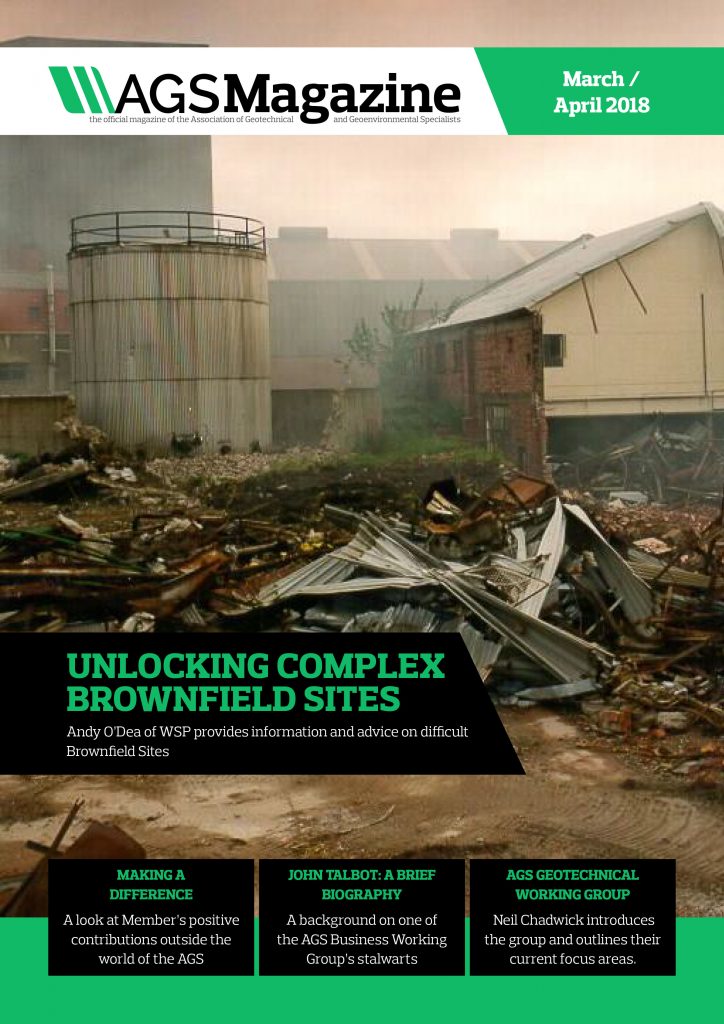
This article was featured in the March/April 2018 issue of the AGS Magazine, which can be viewed here.

Report Data Management

AGS Data Management Working Group: March 2018 Meeting Update

- by
Tags: Featured

The first AGS Data Management Working Group meeting of 2018 took place on 7th March 2018 and the Data Management Leader, Jackie Bland of Geotechnics, has provided an update on the top three current issues the Data Management Working Group are discussing.

5 Year Plan
The Data Management Working Group have been discussing their five year plan, in order to know what the Group will be doing during the next five years. The plan was drafted in this meeting.

AGSi / Ground Modelling
Transferring ground models is a holy grail for the Data Management Working Group and the topic has been discussed on and off for the last five years. The sub-group working on this issue has been recently reassembled to continue their good works.

ERES Code Approval
Environmental / Contaminant codes are the key to AGS Data transfer for geoenvironmental laboratories – if there is no code available for a specific contaminant, then no data can be transferred. The AGS Laboratories Working Group and AGS Contaminated Land Working Groups have been informed of this issue and have agreed to take over the process of authorising the codes. However, guidelines will need to be drafted before this can happen.

Report Loss Prevention

AGS Loss Prevention Working Group: January 2018 Meeting Update

- by
Tags: Featured

The first AGS Loss Prevention Working Group meeting of 2018 took place on 23rd January 2018 and the Loss Prevention Leader, Hugh Mallett of BuroHappold, has provided an update on the top three current issues the Loss Prevention Working Group are discussing.

Loss Prevention Guidance (formerly known as the “Tool Kit”)
All the former toolkit papers have now been reviewed, checked and re-drafted. The papers that had become no longer relevant to current practice have been archived. All the other 23 papers will all be re-issued as the “AGS Loss Prevention Guidance – 2017” at AGS Members’ Day on 11th April 2018. (The 2017 date refers to the date the laws and legal citations were checked). The Loss Prevention Guidance is important to the AGS as the Guidance provides a substantial body of advice to members on matters ranging from the basis upon which members are appointed to provide their professional services, the potential for professional liability and how this can be managed, through to the risks of working alone and the implications of the Freedom of Information Act. The Guidance provides essential information for all members and their staff. Knowing that the legal aspects have all been checked for current relevance and up-dated should increase the confidence of member’s employees in dealing with these matters. AGS Members should always aware that specific matters can always be discussed via the AGS legal advice line managed by BLM Solicitors.

Loss Prevention Alerts on the Case of MT Hojgaard AS v E.ON (LPA 65), Construction Act Payment Provisions (LPA 66) and Japanese Knotweed (LPA 67)
These Loss Prevention Alerts have been developed and prepared over the last year. All three LPA’s were published on the AGS website in January and February 2018. The three new Loss Prevention Alerts respond to recent issues that have been raised with or on behalf of the Working Group. They provide members with an explanation of the issues that gave rise to concern and advice as to how to mitigate potential risks. The LPA’s can be downloaded here.

The Shortage of Reservoir Panel Engineers
A Position Paper highlighting the issue of the shortage of reservoir Panel Engineers has been drafted and discussed at AGS Senate. This is not solely an AGS matter of concern and it is proposed for the AGS Chairman to discuss the paper and the issues it raises to the President of the ICE. The shortage of registered Panel Engineers was identified by a member of the Loss Prevention Working Group as a looming problem due to the increased required for inspection of reservoirs, the decreasing number of persons qualified to do so and the difficulties of entry onto the register for young engineers. The position paper to be discussed with the ICE is very much a plea for action to address this gap between the requirements of the regulations and the ability of the wider industry to deliver people with the necessary skills and experience to fulfil those responsibilities.

News

Supporting the Aldous Bill

- by
Tags: Featured

The AGS have joined a confederation of almost 70 trade bodies and industry groups to back the so-called ‘Aldous Bill.’

The aim of the Aldous Bill (named after Peter Aldous MP who introduced it), is to change the practice of retentions and protect monies from insolvency; hopefully releasing millions of pounds back into the industry. To put it into perspective, the abuse of retentions has been abandoned by many other countries, including the USA, Germany, France, New Zealand, Australia and Canada. Yet here in the UK, recent government research indicated that £700 million worth of retentions was lost as a result of insolvencies over the past three years. This means that for each working day, the construction industry is haemorrhaging almost £1 million of cash retentions.

This statistic alone justifies urgent intervention to ring-fence the monies, but in the aftermath of the Carillion liquidation, there is an unprecedented campaign from the industry calling on government to act. Proposals to stop the abuse of retentions have been made before, but in January 2018 the Aldous Bill passed its first reading unopposed and as we approach the second reading on April 27th ‘Aldous Bill’ has the broad backing of many industry associations, and cross-party support from over 100 MPs.

For further information, visit the BESA website.

News Data Management

Version 3.1 of the AGS Format to be retired from 8th March 2018

- by

An earlier version of the digital data transfer format used to transfer ground investigation, laboratory testing and monitoring data rapidly between contributing parties to a geotechnical or geoenvironmental project will cease to be supported from 8th March 2018.

Version 3.1a of the Association of Geotechnical and Geoenvironmental Specialists (AGS) digital data transfer format, the so called ‘AGS Format’, was published in March 2005 and has been widely adopted within the ground engineering industry.

In May 2010 version 4 of the AGS Format was published, and has been gaining users and popularity since then. The latest 4.0.4 update was released in February 2017 in response to new laboratory industry standards and updated UK practice, and contains many features that are not available in the old 3.1 version.

The maintenance and updating of the AGS Format is carried out by a working group of volunteers. The decision to retire AGS 3.1 has been taken in order to allow the working group more time for future developments, and to speed up the response times to queries posted on the website.

Jackie Bland, Leader of the AGS Data Management Working Group said:

“This does not mean that industry colleagues will have to stop using the AGS 3.1 format, but it simply means that the working group will no longer respond to queries on 3.1 or its associated codes.

This should free up time to provide a swifter response to queries related to AGS4, which should now be the go-to choice for the efficient transfer of ground investigation, laboratory testing and monitoring data.”

Notes to Editors:
In 1991 the Association of Geotechnical and Geoenvironmental Specialists (AGS) set up, and subsequently has supported, a Working Group to establish and maintain a digital data transfer format.

This format, known to many simply as ‘AGS Format’, has now been generally accepted as the most appropriate means to transfer ground investigation, laboratory testing and monitoring data rapidly between the contributing parties to a project that involves geotechnical or geoenvironmental elements.

Since its first publication in 1991 the AGS Format has become the de-facto industry standard for the reliable transfer of ground engineering data in the UK and has been adopted and adapted for use around the globe, including Hong Kong, New Zealand, Singapore and Australia.
The AGS Format enables transfer of geotechnical and geoenvironmental data in a digital form. It allows for the standardised representation of factual information, focusing on field and laboratory test results and monitoring data. AGS Format data are typically generated by a ground investigation specialist, a testing laboratory or on-site drilling crews and technicians and then shared with all project team members, be they designers, or contractors carrying out construction.

This team then uses the data without time consuming and expensive re-keying of data with the associated potential for errors or incomplete data entry.

Following completion of the project, the AGS Format data is easily archived and passed into the asset management sphere, for retrieval at a later date without requiring knowledge of the software used in its generation, or a requirement to have access to that software.

For more information contact:
Katie Kennedy
Association of Geotechnical & Geoenvironmental Specialists
Forum Court, Office 205
Devonshire House Business Centre
29-31 Elmfield Road
Bromley
Kent BR1 1LT

Tel: +44 (0)20 8658 8212
Email: ags@ags.org.uk
Website: www.ags.org.uk

Article Business Practice Contaminated Land Data Management Executive Laboratories Loss Prevention Safety

AGS Members’ Day 2018 – Programme

- by

AGS Members’ Day 2018 is taking place on Wednesday 11th April at the National Motorcycle Museum in Birmingham.

Celebrating 30 years of the AGS, this full day event will see a series of industry experts present on topics such as sustainable remediation, Eurocode 7, sheer box testing and mineworking remediation. There will also be an extended Annual General Meeting and summary reports on each of the AGS’ Working Groups;

Introduction
Neil Parry, AGS Chair and Technical Director at Geotechnical Engineering

Business Practice Working Group Report
Sally Hudson, Regional Manager at Coffey

Data Format Working Group Report
Jackie Bland, IT Manager at Geotechnics

Loss Prevention Working Group Report
Hugh Mallet, Technical Director at BuroHappold Engineering

Working with the new BS ISO 18504:2017 – Sustainable remediation
Dr Paul Nathanail‎, Managing Director at Land Quality Management

Geotechnical Working Group Report
Neil Chadwick, Associate, Geotechnics at Arup

Laboratories Working Group Report
Dimitris Xirouchakis, Director of Laboratories at Structural Soils

Contaminated Land Working Group Report
Vivien Dent, Associate Technical Director, RSK

Ch-ch-ch-ch-Changes: Eurocode 7 in 202X
Andrew Bond, Director at Geocentrix

Safety Working Group Report
Adam Latimer, Director at Ian Farmer Associates

AGM and Awards

Bridging the Gap between Investigation, Testing, Design and Construction – Case Study and Panel Discussion
Yuli Doulala-Rigby (Tensar International), Dr. Gary Fowmes (Warwick University), Tracey Radford, (Atkins), Dave Hutchinson (ex Network Rail), Jim Webster (Kier Chief Materials Engineer), Patrick Waterhouse (Bowdon Consulting) and Dimitris Xirouchakis (Structural Soils). Panel discussion to be compared by Claire Smith (Editor of Ground Engineering Magazine).

Mineworking Remediation
Scott O’Neill-Gwilliams, Technical Director at AECOM

Legal issues in connection with the use of the AGS Digital Data format

Guy Lane, Partner at BLM

Closing Summary
Neil Parry, AGS Chair and Technical Director at Geotechnical Engineering

The programme can be viewed here.

MEMBERS’ DAY SPONSORS

Soil Engineering
With over 50 years of experience, Soil Engineering are one of the country’s foremost Ground Investigation and Specialist Grouting Contractors. The comprehensive in-house geotechnical laboratory, continually updated plant fleet, and ongoing investment in training and staff development, allow Soil Engineering to provide a reliable and cost-effective solution for any geotechnical project, throughout the UK.
www.soil-engineering.co.uk

AmbiSense
AmbiSense is a technology company operating in the environmental sector. We build real-time sensor platforms to generate unique insight about a multitude of industrial and environmental issues to help our customers solve complex environmental problems. Our signature product, GasfluX is the world’s first continuous gas and flow monitoring device for ground-gas applications. The technology enables, real-time monitoring of landfills, brownfield sites, onshore O&G facilities and industrial sites.
www.ambisense.net

Concept
Concept specialises in the design and implementation of highly complex geotechnical, geo-environmental and structural site investigations. Our client base includes some of the UK’s largest Engineering Consultancies, Developers, Project Managers and Public Bodies.
We offer a one stop planning, contracting and when required interpretative service which includes every aspect of investigative work required for a new development.
www.conceptconsultants.com

Envirolab
Envirolab provides laboratory services spanning a broad organic and inorganic portfolio. Our reputation for excellence is built on continually providing our clients with reliable results delivered on time and within budget. Our UKAS and MCERTS accreditations guarantee our commitment to quality. We are the utterly reliable analytical laboratory.
www.envlab.co.uk

Fugro
Fugro provides geo-intelligence and asset integrity services worldwide. With experts in testing, mapping, measuring and investigating the built and natural environments we help clients reduce uncertainty and manage risk. We offer clients the widest range of site investigation capabilities to deliver a digital replica of the subsurface.
www.fugro.com

Geotechnical Engineering
Geotechnical Engineering Ltd is the UK’s largest privately-owned ground investigation contractor, renowned for providing a range of innovative ground investigation services for thousands of land-based projects since 1961. From Utility Surveying to all aspects of ground investigation and having our own UKAS accredited laboratory, we are proud to call ourselves industry experts.
www.geoeng.co.uk/

i2 Analytical
i2 Analytical is an leading independent testing and analytical laboratory. Our Geotechnical department supports a range of sectors including Civil Engineering and GeoEnvironmental contractors/consultants. We also have expertise in asbestos testing and perform a range of chemical analyses using state of the art techniques on waters, soils and associated materials.
www.i2analytical.com

In Situ Site Investigation
In Situ Site Investigation is a multi-national specialist geotechnical and geo-environmental site investigation company, which specialises in the use of Cone Penetration Testing (CPT) techniques including seismic, shear vane, video cone, pressuremeter, magnetometer, MiHpt & MOSTAP sampling. Our specialised rigs enable us to work in most locations including railways, marine, Brownfield sites, river slopes and rugged, mountainous terrain.
www.insitusi.com

Land Science
We are an established ground investigation specialist in contaminated land and ground engineering projects for public and private clients in a wide range of scenarios including development, infrastructure, civil engineering, legal, and regulatory. We have bases in London and the South and operate our own rigs and a geotechnical laboratory.
www.landscience.co.uk

Lankelma
Lankelma is a leading company in the field of Cone Penetration Testing (CPT) & site investigation for construction projects both onland and overwater. With our large fleet of CPT rigs and ingrained knowledge we go beyond simply supplying accurate and reliable data, and provide our clients with high-value interpretation and engineering input for their projects.
www.lankelma.co.uk/

NHBC
Established in 1936, NHBC sets standards for its registered house builders and works to improve the construction quality of the homes they build. This is ultimately for the benefit of homeowners.
NHBC is a non-profit distributing organisation with no shareholders that dedicates resources and technical expertise to support the industry in raising the standards of new homes.
www.nhbc.co.uk/lqe

Quantum Geotechnical
Quantum Geotechnical, based in South Wales and South West England, working nationwide, provides a comprehensive service across the ground investigation, geotechnical contracting and geotechnical consultancy sectors. We have a specialist fleet of multi-purpose drilling rigs, a UKAS accredited in-house laboratory and a team of experienced and chartered engineers and geologists.
www.quantum-geotech.co.uk

Robertson Geologging
Robertson Geologging (RG) pioneered the development of wireline conveyed, slim-hole, digital logging systems and techniques. With extensive international experience of providing geophysical instrumentation and onsite services, RG operates in the geotechnical, mining, water, environmental and hydrocarbon sectors. RG headquarters in North Wales house the main design, development and assembly capability.
www.geologging.com

SOCOTEC
As a leading geotechnical services provider, SOCOTEC – formerly ESG – offers a diverse range of geotechnical and geoenvironmental investigation capabilities. From deep boring, wireline drilling and dynamic sampling to specialist in situ testing, in-house laboratories and engineering consultancy, SOCOTEC’s service offering covers the whole project lifecycle, through design, construction and the built stages.
www.socotec.co.uk

Structural Soils
Structural Soils Ltd has evolved into a national, multidisciplinary integrated, geotechnical and geo-environmental Site Investigation Company with the proven capability, capacity and confidence to undertake contracts of any size, in any location and virtually any scope. The company undertakes contracts across the UK through its offices in Bristol, Castleford, Coventry, Glasgow, Hemel Hempstead and Tonbridge.
www.soils.co.uk

Landmark Information
Landmark’s Envirocheck provides industry-leading site-specific environmental reports that analyse and assess risks for Phase 1 studies. The Envirocheck Analysis digital platform and mobile app was launched to revolutionise site assessments by enabling users to instantly overlay an extensive archive of historical mapping and environmental data, online, to immediately determine associated risks.
www.landmark.co.uk

Article

The National Quality Mark Scheme for Land Contamination Management

- by
Tags: Featured

As many will know, the NQMS was launched by the Land Forum in January 2017. It is administered for the Land Forum by CL:AIRE. It is a system designed to ensure that land contamination management work meets necessary technical and regulatory standards. It applies in particular to the presentation of environmental information to the regulators in the form of reports setting out both factual and interpretative information.

Reports are prepared in line with good practice and signed off by a suitably qualified and experienced person (SQP) registered under the NQMS who ensures that:

• The work has been planned, undertaken and written up by competent people who have relevant experience and/or qualifications in their respective disciplines.
• The underlying data has been collected in line with established good practice procedures and its collection has been subject to control via established quality management systems.
• The data has been processed, analysed and interpreted in line with established good practice and any specific advice provided by the relevant regulatory authorities or regulatory bodies.
• The reports set out recommendations or conclusions that are substantiated by the underlying data and are based upon reasonable interpretations.
• Any limitations in the data or uncertainties in the analysis are clearly identified along with the possible consequences of such limitations.

The scheme is voluntary and has been designed to operate alongside and within existing quality management systems. It has the support in principle of the Department for Communities and Local Government (DCLG), the Department for Environment, Food and Rural Affairs (DEFRA), Natural Resources Wales (NRW) and the Environment Agency (EA).

The Environment Agency in particular, fully support the scheme and have a position statement (J9) in the land contamination section of their principle groundwater protection document: The Environment Agency’s approach to groundwater protection (GP3)
In providing a Quality Mark to reports, the aim is to provide assurances to problem holders and regulators alike that land contamination issues have been adequately managed. The intention is to help speed up regulatory permissions or decisions on regulatory compliance resulting in savings to both public and private sector participants.

The scheme applies to;
• Desk Studies/Preliminary Risk Assessments
• Site Investigations, Generic or Detailed Quantitative Risk Assessments
• Remedial Options Appraisals, Remediation Strategies
• Remediation Verification and Monitoring Reports
• Or a combination thereof.

Although the NQMS can be applied to the management of land contamination under a range of regulatory regimes, its primary focus is to improve the quality of work done to manage land contamination under the Town and Country Planning System. However, it could also be applied to Part 2A, environmental permitting, pollution incidents and enforcement actions.

The SQP Provider is the organisation which examines the capabilities of prospective SQPs and compiles a register of their details. This role is currently carried out on behalf of the Land Forum by SiLC (Specialist in Land Condition Register). There are two routes whereby an individual can become an SQP. Someone who is already a registered SiLC can take an on-line Conversion Course which leads to an on-line multiple choice exam. If the required marks are achieved, the person will be registered as an SQP in addition to being a SiLC. For someone who is not a SiLC and has the required expertise and experience, they can apply via examination and interview to become both SiLC and SQP. There are currently 84 registered SQPs and 194 registered SiLCs. Those SiLCs who have not yet taken the on-line conversion course are encouraged to do so. The more SQPs there are to fulfil the need, the more inclined clients will be to specify a requirement for an SQP so that declarations can be submitted for the reports that relate to their project.

The scheme works by the SQP making a Declaration, registered with CL:AIRE, to confirm that the principles outlined above have been followed and they can certify that the work has been carried out by appropriately qualified people, that proper quality control procedures have been followed and that the recommendations given and conclusions drawn, including uncertainties, are appropriate and can be justified by the data on which they are based.

There are currently 17 Declarations that have been registered with CL:AIRE. There should be many more. For the scheme to gather momentum, more clients need to be made aware of the scheme and the benefits. SQPs are the ambassadors that can achieve this. A client will not request that a Declaration be made unless they know about the scheme and can see the benefits. So, SQPs – educate your clients, generate interest, and thereby make the scheme work. You have put in the effort to become an SQP, now make it worthwhile.

The potential benefits of this scheme are enormous. It is not intended to remove the need for regulatory scrutiny. However, the purpose is to enable regulators to spend less time and resources on reports which have a Quality Mark thereby enabling them to concentrate more of their time on those reports which do not have this quality designation. The benefits to a developer are less potential for delay in the approval of land condition reports as part of the planning process.

For the scheme to be more widely used there needs to be greater awareness of the scheme within regulatory organisations, within client organisations such as developers and generally within the contaminated land community.

Obviously, the NQMS is in its early stages and still needs to prove that it does result in improved standards. The Land Forum are in the process of developing an audit process and SiLC have prepared a disciplinary procedure to deal with any complaint that an SQP has not followed the Code of Conduct. In due course the EA will be doing their own audit and will be sharing the results with the Land Forum. It is anticipated that by these means confidence in the NQMS can be established.

Some of the words in this article rely heavily on the documents on the CL:AIRE website. Where comments and observations are made which are not on the CL:AIRE website, these are the thoughts of the authors of this article. Please visit the CL:AIRE website for further information.

Roger Clark, Marlowclark Consulting Limited
Angela Haslam, Environment Agency
Phil Fitzgerald, Environment Agency

This article was featured in the January/February issue of the AGS Magazine, which can be viewed here.

News Data Management

A New Era for AGS Data Format

- by
Tags: Featured

The AGS Data Format organisation is going through a period of change within AGS to ensure it can meet the demands of a digitalised industry. The way it is currently supported has to change. Jackie Bland explains…

The AGS Data Format stands as one of the most useful digital standards ever developed for our industry. It’s the product of collaboration between like-minded technical experts who all saw the need to share site investigation data in a standard way between their different organisations, irrespective of the software and people involved. Yet for many its purpose is unknown or not understood.

The AGS Data Format saw a group of enthusiasts come together with no budget and little dedicated time to create something that has become a defacto standard within the UK Site Investigation industry. Expanding on its UK success, it has been adopted abroad in countries such as Hong Kong, Australia and New Zealand. It anticipating the demands of digital construction (BIM) when it was created 25 years ago.

Throughout its life it has been maintained by the volunteers of the AGS Data Management Committee, with little or no budget towards its upkeep. Today we are rebuilding the technical infrastructure that sustains the Data Format to ensure that it will stand for the next 25 years. To support this invaluable work we have taken the decision to put it on a more sustainable footing financially so that we can safeguard it into the future.

The AGS publication ‘Electronic Transfer of Geotechnical and Geoenvironmental Data’ (AGS data format versions 1-4.0) has, to date, been maintained using a one-time fee for registered users. As the AGS Format’s use has grown, the process of responding to queries, extending the format and maintaining the website has become costly and time consuming which needed to be addressed.

While the publication itself will still be completely free to download and use. The AGS has decided that an annual fee should be payable as a contribution to its upkeep for those wishing to make regular use of data transferred in this way and to interact with the Data Management Group when proposing new codes and needing answers to queries.

From 2018, the annual fee for AGS member organisations is £50 + VAT and annual fee for non-member organisations is £150 + VAT.

From April 2018, the existing list of Registered Companies on the website will be cleared and only those organisations and individuals who have paid the fee for that year will be included in the revised list. A logo and certificate will be supplied annually by AGS to those who are registered for inclusion on their website, email and social media feeds to demonstrate their registration and involvement.

We would ask that, if you are a consumer of AGS data, you check that any company supplying you with AGS data is shown on the list of Registered Users.

The benefits of being registered for AGS Data include:
• Ability to use the AGS Format for any application
• DOC and RTF versions of the Publication
• A copy of and the ability to use the AGS Data Logo on your SI reports and logs
• The AGS Data Dictionary in CSV or Excel format
• Company listing on the Registered list

Visit the AGS Data Format website here to become a registered user of AGS Data Format or email ags@ags.org.uk.

Article Business Practice Executive

Q&A with Sally Hudson

- by
Tags: Featured

Sally Hudson BSc (Hons), MSc, DIC, CGeol, FGS
Regional Manager and Associate Geotechnical Engineer at Coffey Geotechnics Ltd, a Tetra Tech Company

After nearly 30 years in the geotechnics industry, I have worked on many aspects of ground engineering and currently have responsibility for technical management of a wide range of operations and for design delivery. I have a background in site investigation but have since worked for design consultancies for many years on significant transport and energy infrastructure schemes, and so I am well placed to represent the consultancy sector as part of this important trade association.

What or who inspired you to join the geotechnical industry?
I joined the industry as a young geologist interested in all things sub-surface. One career open to a geology graduate is that in ground engineering, a route I chose and have not looked back. I specialised and further qualified as an engineering geologist and then geotechnical engineer, quickly becoming hooked on finding out about the ground and its behaviours during interaction with the built environment and the associated geo-hazards.

What does a typical day entail?
As Coffey is a specialist geotechnical design consultancy working in all sectors in all corners of the globe, it’s difficult to pin down a typical day. I deal with delivering projects and managing our technical team and workload in almost all aspects of ground engineering. The day can comprise attending design team meetings for major projects, inspecting highway earthworks, reviewing tender designs or looking at in-country health and safety and design risks associated with working on overseas ground investigations.

Are there any projects which you’re particularly proud to have been a part of?
Certainly; High Speed 2 has presented a unique set of challenges for the geotechnical industry to tackle and I have been involved in this prestigious scheme in one form or another since 2012. We have had roles at tender assessing the geodynamic effects of high speed rail traffic on UK soils and how to mitigate this at unprecedented design line speeds, and also the engineering of heave of overconsolidated clay in very deep cuttings.

What are the most challenging aspects of your role?
The main challenge is always the tight timescales imposed on us by many of our clients – either due to them not being aware how much they will need geotechnical specialist input on a tender or design until very late in the day, or due to delay of award date of a scheme but not of the delivery date. This constraint can affect the entire design team, not just in geotechnics.

Another key challenge is trying to ensure that the ground investigation data we rely on so heavily as designers is available in AGS format to those that need it. It is staggering how difficult it often is to obtain the data that we know has been commissioned and produced but has not made it along the chain to those who need it most.

What AGS Working Group(are you a Member of and what are your current focuses?
I have been on the Executive Committee and now the Senate since 2014 and am a member of the Business Practice Working Group. Working with the Marketing Sub-Group we have overhauled the bye-laws and are looking at how to widen the AGS membership. Most recently, I have also joined the newly formed Geotechnical Working Group and have specific focus on addressing key issues such as excavation safety during in-situ tests like permeability and soakaway.

What do you enjoy most about being an AGS Member?

I have followed the AGS since my graduation and from an early stage in my career I have been glad of the advice given in the AGS guidance notes and publications such as the recently revised guidance on the selection of laboratory tests for construction schemes. Now I have the opportunity to help out and return the favour!

What do you find beneficial about being an AGS Member?
I am long-standing member of the geotechnical community and I am always assured that the AGS are there looking out for the interests of all geotechnical and geo-environmental practitioners and promoting best practice and quality. I can access a plethora of advice and guidance documents produced by the AGS for use by all members and for use in educating clients, colleagues and suppliers.

Why do you feel the AGS is important to the industry?
There is no other trade body dealing with the geotechnical and geo-environmental industry as a whole. There is a huge amount of work being done by members of the AGS alongside their day job to promote excellence and safe working practices across the industry. The well-established data format is hugely beneficial and as we deliver more schemes in BIM this format really comes into its own.

What changes would you like to see implemented in the geotechnical industry?
I would like to see greater awareness of the AGS and its activities. Does everyone know there is a legal help line who can assist in advising on tricky contractual matters? I encourage everyone to sign up to the AGS website and talk to your AGS company representative about the benefits of membership. I look forward to seeing you all at the AGS Members’ Day.

This Q&A was included in the January/February issue of the AGS Magazine, which can be viewed here.

Report Safety

AGS Safety Working Group: November 2017 Meeting Update

- by
Tags: Featured

The final AGS Safety Working Group meeting of 2017 took place on 14th November 2017 in London and the Safety Leader, Adam Latimer of Ian Farmer Associates, has provided an update on the top three current issues the Safety Working Group are discussing.

Trial Pitting Guidance
Trial Pitting has been a staple tool used within the ground investigation industry to obtain good material descriptions, samples and test data. However, with numerous changes in legislation (e.g. working at height regulations), we need to ask ourselves whether the current methodology is still fit for purpose or whether we need to totally rethink trial pitting across the industry. The AGS Guidance on Trial Pitting is regularly reviewed by the Safety group and is one of the most popular downloads by AGS Members. The group are also working on the publication of an article specifically on trial pitting, which will be in a future issue of the AGS Magazine. The AGS Guidance for the Safe Excavation of Trial Pits can be downloaded here.

Safety Alerts/Near Misses

As an industry the reporting of safety alerts, near misses and accidents remains low compared to other industries. This vital information will allow both the AGS and wider industry to continue to improve in respect of H&S performance and awareness. We actively encourage AGS Members to report any safety alerts and near misses to the AGS so we can share learnings across the wider audience. As an industry, we all need to work collaboratively to improve H&S awareness.

Increasing Participation in the Safety Working Group
The Safety Working Group are a small and dynamic team, but they would like to increase member participation in the group, which is vital to maintain a fresh and vibrant approach to H&S topics. The Safety Working Group produces numerous guidance documents which are free to download to Members which can be viewed here. If you wish to be part of the AGS Safety Working Group, please contact the AGS Secretariat by emailing ags@ags.org.uk.

Report Business Practice

Business Practice Working Group: November 2017 Meeting Update

- by
Tags: Featured

The mission of the AGS Business Practice Working Group (BPWG) is to address and, where appropriate, improve the business practices of not only the Association, but the general geotechnical and geoenvironmental community. Led by John Talbot, the BPWG takes a lead in promoting the AGS and enhancing its membership with the aim of regenerating the AGS and increasing its overall reach.

The group had its last meeting of the year on 23rd November in London, and is currently focusing efforts on the review & reform of the AGS and marketing;

Review & Reform of the AGS
Having made huge progress in reforming the working practices of the AGS over the last two years, the Group is working on this initiative to increase awareness of the Association through the AGS’ social media channels (Twitter and LinkedIn) and through the ongoing rejuvenation of the AGS website. Since January 2017, the AGS has seen a 30% increase in Twitter followers and 27% increase in LinkedIn followers.

The AGS is also working to increase the number of seminars it holds year on year. In 2017, we organised a Geotechnical Data Conference at the National Motorcycle Museum, which saw attendance from over 140 delegates. In 2018, we’ll be holding our annual Members’ Day event and a Ground Risk event in London this September.

Marketing of AGS to the Wider Geotechnical Community
This initiative started last year and is starting to gather momentum, thanks to the drafting of the AGS Business and Marketing Plans and the launch of AGS Magazine.

This is the second issue of AGS Magazine, which has a huge reach of 6,000 subscribers across the geotechnical and geoenvironmental industry. I’m sure this figure will continue to rise month on month.

Article

GE article on AGS Geotechnical Working Group

- by
Tags: Featured

Neil Chadwick, AGS Geotechnical Working Group Leader, recently spoke to Ground Engineering about the aims and focuses of the new Working Group which was set up in 2017. The article can be found here.

If you are interested in joining the Geotechnical Working Group, please contact the AGS Secretariat at ags@ags.org.uk