 Search
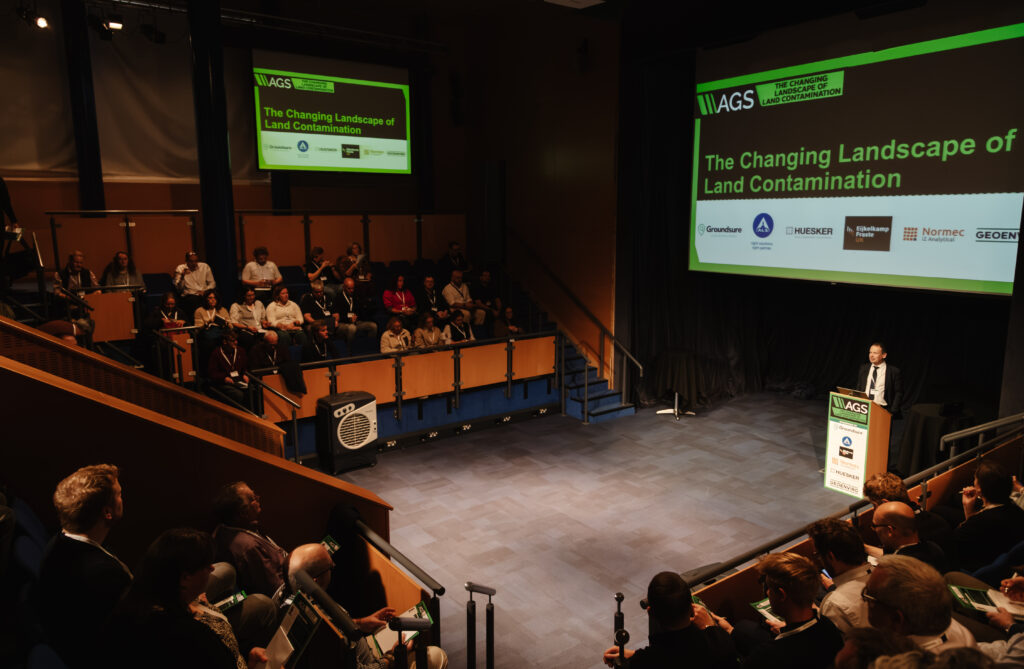
The Changing Landscape of Land Contamination conference was held on 15th October 2026 at Thinktank Birmingham Science Museum. The sellout event welcomed 170 delegates for a full-day programme examining the technical, legal and regulatory developments shaping the land contamination sector.
Across four sessions, speakers explored how updated standards, emerging contaminants, improved monitoring and changing legal expectations are influencing professional practice. The programme also included a panel discussion titled Land Contamination: Meeting Technical, Societal and Legal Expectations.
Session 1
Chaired by Geraint Williams (Associate Technical Director at HKA and AGS Chair Elect), Session 1 began with Professor Paul Nathanail (Director at Land Quality Management), who discussed BS 10175:2026 and its role in supporting a professional approach to the investigation of potentially contaminated sites. He outlined the importance of robust information throughout site characterisation, risk assessment and remediation verification, particularly in supporting the safe redevelopment of post-industrial brownfield land.
Dr Anna Willetts (Partner at Gunnercooke) and Samantha Riggs (Barrister at 25 Bedford Row) followed with a legal perspective on landfill, considering the regulatory and liability issues that influence decision-making in practice.
Session 2
Following a refreshment break, Session 2 was chaired by Stephanie Cox (Director at E3P and member of the SoBRA Executive Committee – Early Careers). Dr Rob Sweeney (Technical Director at CL:AIRE) presented an update on work to modernise 15 Department of the Environment industry profiles created more than 30 years ago. The revised profiles address contaminant groups including per- and polyfluoroalkyl substances (PFAS) and persistent organic pollutants (POPs), with information presented through an interactive matrix and supporting profile pages.
Pagen Spooner (Geo-Environmental Consultant at EPG) then explored the benefits of measuring dissolved methane when interpreting ground-gas results. Drawing on recent research, Environment Agency guidance and case studies, Pagen considered uncertainties in current field and laboratory sampling methods and explained how dissolved methane probes can provide clearer evidence for risk assessment and design decisions.
Session 3
After lunch and networking opportunities, Session 3 was chaired by Dr Rob Sweeney. Dr Paul McMahon (Associate Technical Director at RSK Geosciences), presented a case study on RSK Geosciences’ approach to developing and applying Sustainable Management Practices. He explained how the company’s digital tool helps project teams identify, track and showcase better practice while supporting more sustainable outcomes for land development and management. The presentation also highlighted the importance of integrating climate risk and resilience into geo-environmental assessments.
The session concluded with a panel discussion chaired by Professor Paul Nathanail featuring Pagen Spooner, Dr Anna Willetts, Christopher Swainston, Barry Mitcheson and Dr Paul McMahon. The panellists answered audience questions on the technical, societal and legal expectations affecting the land contamination sector.
Session 4
The final session was chaired by Claire Dickinson (Director at Geo-Environmental Matters and SiLC PTP member). Dr Cecilia MacLeod (Managing Director and Co-Founder at Anthera Remediation Technologies) opened with a presentation on developments in the remediation of PFAS in soils and waters.
The final presentation came from Steve Forster (Director at Remedia Group), who asked whether current approaches to asbestos air monitoring during remediation provide sufficient assurance for nearby homes, schools, workplaces and public spaces.
It was a highly successful event that provided valuable opportunities for professionals across the sector to share technical knowledge, discuss developing regulation and explore practical responses to emerging challenges in land contamination.
The AGS extends its thanks to all speakers and sponsors, including Groundsure, ALS, HUESKER, Eijkelkamp Fraste UK, Normec i2 Analytical and GeoEnviro Solutions.