 Search
Sustainability is a great catch-all term, covering everything from carbon reduction and water use through to wellbeing and inclusion. But this breadth also presents a challenge. How can an engineer, or a procurement lead, or a yard technician improve sustainability? What does sustainability even mean for our day-to-day work?
Recognising this challenge, the European Federation of Foundation Contractors (EFFC) and Deep Foundations Institute (DFI) have been collaborating to produce a series of free sustainability guides specifically for the geotechnical sector. The EFFC represents foundation and geotechnical contractors across Europe, while DFI represents geotechnical specialists mostly in North America, as well as Europe and India. The working group is co-chaired by Luke Deamer (Keller and EFFC) and Kimberly Martin (Keller and DFI).
Each free guide uses four questions to help geotechnical employees improve sustainability:
- What is the area of sustainability? What does it mean to geospecialists?
- Why does it matter? What drivers, or value, is behind these initiatives?
- How can geotechnical companies and individual employees improve that area of sustainability?
- Measure – What metrics can we use, at a company and project level, to measure their progress and set targets?
Importantly, the approach underpinning the guides aligns directly with the AGS Sustainability Charter. Both take an initiative-focused approach, using the United Nations Sustainable Development Goals (SDGs) as a common language to prioritise sustainability topics.
More generally, the EFFC/DFI guides are not written as standards or minimum requirements. Instead, they are practical support documents that share good practice and help organisations identify actions that are appropriate for their own circumstances.
What areas of sustainability are covered?
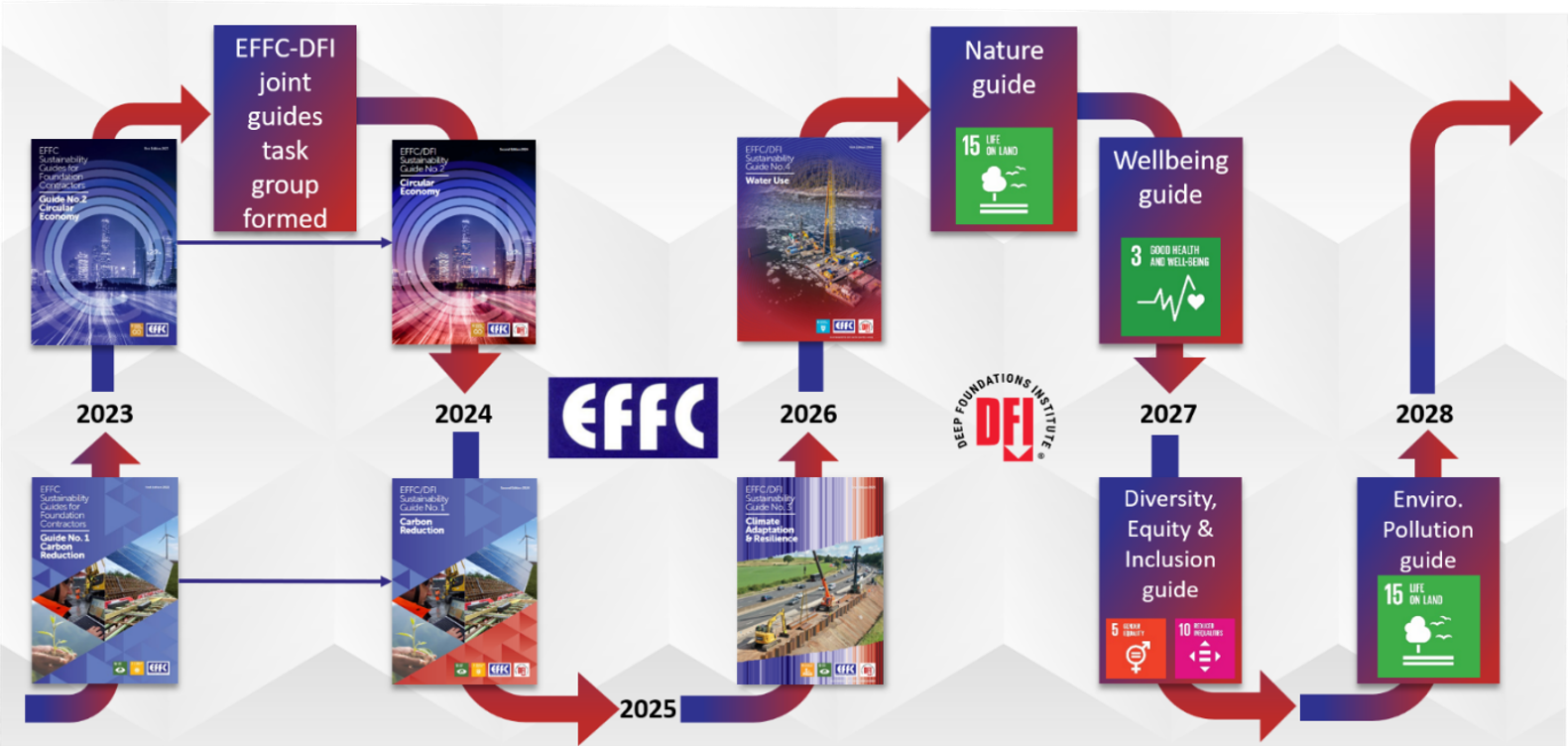
So far, the EFFC and DFI have published four sustainability guides, each focused on a specific sustainability topic that is material to geospecialists.
Carbon reduction
The first guide focuses on carbon reduction, addressing SDG 13 (Climate Action) and SDG 7 (Affordable and Clean Energy). Led by Luke Deamer, who is also an honorary member of the AGS sustainability working group, this guide focuses on carbon savings throughout site investigation, design, operations and office / maintenance yard work. Given the focus on carbon saving in our sector, this guide acts as a signpost to understand concepts, legal requirements, standards and of course practical carbon saving improvements. Later additions include case studies that bring these improvements to life.
Circular economy
The second guide focuses on the circular economy, supporting SDG 12 (Responsible Consumption and Production). The circular economy looks to encourage the use of secondary materials, extend product lifetimes and reduce waste at the end of life. Led by Alice Berry (formerly at Arup and EFFC), this looks to go beyond the typical focus on waste and recycling, instead broadening the approach to include improving resource efficiency and building for reuse. Much like the carbon reduction guide, case studies and a focus on facilitating foundation reuse reflect the research of EFFC and DFI members around the world.
In terms of geoenvironmental work, there is considerable crossover with remediation specialists as we look to minimise waste disposal, maximise material reuse and reduce environmental impacts associated with contaminated land management.
Climate adaptation and resilience
The third guide addresses climate adaptation and resilience, supporting SDGs 11 (Sustainable Cities and Communities) and 13 (Climate Action). Unlike carbon reduction, which focuses on mitigating climate change, adaptation focuses on preparing for the consequences of a changing climate. Led by Marla Gillow, originally a member of the AGS sustainability working group, this took two very different forms. The first of these focuses on how geotechnical designs and specifications should adapt as climate-related hazards change. The second focuses on how geospecialist contractors will be impacted by climate change directly and, therefore, how we need to adapt our operations.
Water use
The most recent guide focuses on water use, supporting SDG 6 (Clean Water and Sanitation). Water is a critical but often overlooked aspect of sustainability, with many of the initiatives taken from water-scarce regions. Construction activities can consume significant quantities of water while also affecting groundwater, surface water and wider catchment systems. Led by Alice Liddell (Sizewell C and EFFC), the water guide looks at minimising water use, groundwater interactions and avoiding water contamination throughout geotechnical projects. The guide explores practical opportunities to reduce water consumption, improve management practices and consider water risks during design and construction.
Looking Ahead
The sustainability journey does not stop here. Three more guides are currently in drafting stage. These upcoming EFFC/DFI guides are being developed to cover the following:
Nature
Led by Cerys Orriss (Aarsleff and EFFC), the nature guide focuses on how contractors and designers can influence nature and biodiversity on their projects. Currently nearing review stage, the guide focuses on core concepts and requirements around nature, supporting SDG 15 (Life on Land). Particularly given the biodiversity net gain requirements on UK projects, the guide has benefited from AGS input on minimising impacts on soil and groundwater ecosystem services.
Wellbeing
Led by Catherine Chauder (Keller and DFI), this guide focuses on wellbeing initiatives for site and office teams. Built from a collection of case studies from around the world, it covers the breadth of wellbeing, from mental and physical health through to financial and social wellbeing, supporting SDG 3 (Good Health and Well-Being). Given the challenges of site and field work, the guide has a particular focus on initiatives that reach field operators.
Gender equality and reduced inequalities
Led by Bradley Falcus (Central Alliance and AGS member), this guide will be the first to formally include AGS as a collaborator with the EFFC and DFI. This guide focuses on inclusion commitments for geospecialists, focusing on improving diversity and the benefits of an equitable approach for everyone in a company. Supporting SDGs 5 (Gender Equality) and 10 (Reduced Inequalities), this guide focuses broadly on gender equality, but also includes other protected characteristics such as disability, race and religion.
These upcoming guides reinforce themes already reflected within the AGS Sustainability Charter, promoting a broader understanding of sustainability that extends beyond environmental impacts to include people, communities and inclusion.
Why do these guides matter to AGS members?
Sustainability is increasingly becoming a business necessity, part of our licence to operate. The EFFC/DFI guides explain that there are multiple drivers for AGS members to improve sustainability.
Legislation
Across the UK, Europe and internationally, there are many legal requirements that impact geospecialists. This spans a broad range of standards, from corporate sustainability reporting, climate disclosures and carbon management, through to environmental performance requirements or engine air quality standards.
Even where legislation does not apply directly to smaller organisations, client requirements frequently pass expectations down through procurement processes and contractual obligations. The guides help make sense of these requirements, highlighting the key points for our sector.
Client demand
Client demand provides a financial incentive for geospecialists to improve sustainability. Whether it’s recognised directly as a weighted percentage of a tender or just a minimum standard to bid on a project / join a framework, public and private sector clients are pushing sustainability in tender documents.
Employee attraction and retention
Sustainability is also increasingly important to employees. As our sector struggles to attract the next generation of employees, sustainability is an increasingly important factor in attracting and retaining talent.
Beyond recruitment and retention benefits, there is a compelling ethical argument. Our sector helps shape the built environment for future generations. We are a carbon- and resource-intensive sector, putting a small, highly-skilled workforce in challenging physical and mental environments. This means we have a responsibility, and a real opportunity, to make a genuine difference for our own workforce, our local communities and the planet overall.
Efficiency
Anything that saves fuel, materials or time ultimately also saves cost. When we think of improvements, often we jump straight to the latest innovations in low carbon technologies, like electric equipment or ultra-low carbon cements. But there are many cheaper, often simpler, improvements we can make first. Many of the guides therefore provide hierarchies or improvement cycles to help prioritise these efficiency savings first, before adopting more innovative technologies.
Banks, investors and insurers
Financial institutions are increasingly assessing sustainability performance when making investment, lending and insurance decisions. Environmental, Social and Governance (ESG) performance is becoming an important indicator of long-term business resilience. Whether it is sourcing green funds for a project, minimising climate risk for insurers or preferential loans based on sustainability performance, these drivers translate sustainability performance into financial savings. For AGS members seeking investment, growth or major project opportunities, sustainability performance is therefore becoming an increasingly relevant commercial consideration.
How can we all make a difference?
One of the greatest strengths of the EFFC/DFI guides is their practical structure.
Rather than discussing sustainability at a purely strategic level, the guides break actions down by business function, helping individuals understand how sustainability relates directly to their role. These improvements are not just limited to engineers either, with advice from HR and procurement leads, through to health & safety and even IT teams. Everything is focused on making sustainability practical and actionable.
Every ‘how’ section begins with quick wins for companies looking to make a start on this area of sustainability. They also end with ‘future looking initiatives’ for those companies that are looking to innovate in these areas of sustainability.
The guides frequently demonstrate that improvements require collaboration across functions. For example, reducing carbon may require design optimisation, procurement engagement and operational changes simultaneously. Similarly, improving circularity can involve designers, remediation specialists, contractors and waste managers, all working together.
Measuring our progress
One of the key focus areas shared by both the AGS Sustainability Charter and the EFFC/DFI sustainability guides is that we need to be able to measure our progress on sustainability.
The guides therefore include metrics and indicators that can be used to monitor progress. Grounded in legislation requirements, standard specifications and geotechnical-specific datapoints, these provide a way to track progress against the initiatives in the guides. Given how we operate as a sector, these metrics are broken down into those for a project level, as well as those at a company level.
EFFC/DFI carbon calculator
Perhaps the most visible example of standardised measurement within the sector is the EFFC/DFI Carbon Calculator. Developed collaboratively by the EFFC and DFI over a decade ago, the calculator enables geotechnical companies to compare the footprint of geotechnical works to using a certified, consistent methodology. This consistency in calculation between geotechnical companies improves transparency and helps clients compare alternative solutions on a common basis. It also enables benchmarking activities, establishing estimated carbon footprints of different geotechnical solutions.
The calculator is currently being digitised in collaboration with Carbone 4. In the meantime though, it has been recognised by the EU as the only sector-specific carbon calculator in EFRAGs recommendations for small and medium enterprises. It has also therefore been written into specifications across Europe, from France to the Netherlands, as a standardised way to calculate and compare carbon emissions.
The EFFC/DFI Carbon Calculator has contributed to a number of calculation initiatives, including the AGS’s own efforts to promote simplified carbon calculations in the geo-environmental sector. Whilst foundation emissions are always an order of magnitude greater than those from ground investigations, both tools are useful for standardising and simplifying carbon calculations.
Conclusions
Ultimately, the EFFC/DFI guides aim to make sustainability practical, actionable and relevant to everyone working in our sector.
The EFFC/DFI sustainability guides provide AGS members with a practical, accessible and free resource to support that journey. Whether the goal is reducing carbon, improving resource efficiency, adapting to climate change or managing water responsibly, the guides help translate sustainability ambitions into tangible actions. By combining practical guidance and case studies with measurable outcomes, they offer a valuable framework for geospecialists, particularly if we’re looking to align with the AGS Sustainability Charter.
A big thank you goes to all the volunteers that have helped write these guides. Particularly, we must give a shout out to the AGS members that have contributed, including Alison Nicholson, Bradley Falcus, Marla Gillow and Chris Swainston. If you would like to be involved in the upcoming guides, particularly on wellbeing or gender equality and reduced inequalities, please contact Luke Deamer or Kimberly Martin.
You can download the guides for free from here: EFFC Sustainability Guidance Archives
There are plenty of webinars summarising the guides to date. You can view these for free on the EFFC or DFI’s website here: EFFC Webinars
Article by Luke Deamer, Group Sustainability Director, Keller