 Search
This article describes work that has been undertaken to begin updating the industry profiles that were created by the then Department of Environment (DoE) over thirty years ago. It covers the reasons for updating the profiles, the content of the new profiles, the review process used to ensure accuracy, and the next steps.
Background
The DoE published a series of 47 industry profiles in 1995. These profiles provide information on the processes, materials and wastes associated with individual industries with regards to land contamination. The profiles have not been updated since their original publication. Changes in legislation, industrial practices and the emergence of new contaminants mean they are now, to varying degrees, out of date; some significantly so. Although there are sections of the profiles that are out of date, they still contain a lot of very useful historical information when carrying out a Stage 1 risk assessment in line with Land Contamination Risk Management. They currently reside in The National Archives and are signposted on the CL: AIRE Water and Land Library (WALL).
In 2023/24, the Environment Agency provided funding to CL:AIRE to undertake a short project to investigate whether the DoE profiles could be better signposted and presented in a more accessible way (Phase 1). As part of Phase 1, an industry questionnaire and workshop were undertaken. A template for the profiles and a beta online portal was created with five draft profiles. The main conclusions of Phase 1 were:
- The profiles are still well-used.
- There is great interest and support in updating the profiles into a tool that is clear, succinct, accessible and searchable on all platforms.
- There is interest in developing some new profiles covering industries that have had contaminative processes on site that are not covered by current profiles.
- It is important to update the profiles to ensure that emerging and persistent contaminants are covered.
In 2025/26 Phase 2 of the project to update 15 of the 47 industry profiles was undertaken with funding from the Environment Agency, Association of Geotechnical & Geoenvironmental Specialists and Natural Resources Wales. Phase 2 involved the five profiles from Phase 1 plus 10 further profiles which were selected from the industry consultation, where feedback was gathered about which profiles were most used or in most need of an update. These are listed alphabetically below:
- Airports
- Chemical works – coatings (paints and printing inks) manufacturing works
- Chemical works – organic chemicals manufacturing works
- Dockyards and dockland
- Dry cleaners (miscellaneous)
- Engineering works – electrical and electronic equipment manufacturing works
- Engineering works – railway engineering works
- Gas works, coke works and other coal carbonisation plants
- Oil refineries and bulk storage of crude oil and petroleum products
- Printing and bookbinding works (miscellaneous)
- Railway land
- Road vehicle fuelling, service and repair – garages and filling stations
- Sewage treatment works
- Timber treatment works/timber products manufacturing works
- Waste recycling, treatment & disposal sites – landfills and other waste treatment or waste disposal sites
Note that (5) and (10) were part of the Profile of miscellaneous industries which actually contains six separate industries. Also the steering group decided to combine the two timber industry profiles hence the 16 profiles listed above.
Layout & Content
The industry profiles are presented at claire.co.uk/doe where there is an initial landing page that explains the project and gives a link to the overview table. Figure 1 provides a screenshot of part of this overview table. In the table, 15 industries have been listed alongside potential contaminants in generic groupings that may be associated with the different industries. As mentioned earlier, the aim was not to rewrite the original profiles, but to update them for contaminant groups such as per- and polyfluoroalkyl substances (PFAS) and persistent organic pollutants (POPs) and present the information in a more accessible way, via a simple interactive online matrix.
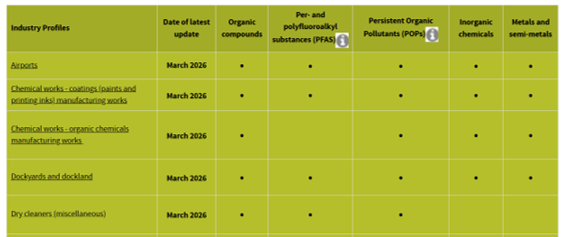
Figure 1: Screenshot of part of overview table.
Each industry profile is hyperlinked to a dedicated page giving a greater level of detail about the background of the profile and associated potential processes and operations relevant to that profile. In the updated profiles this text is kept succinct with the emphasis on the potential contaminants of concern, along with likely locations of contamination (as shown in Figure 2). Table 1 explains some of the rationale behind the contaminant groupings and likely locations.
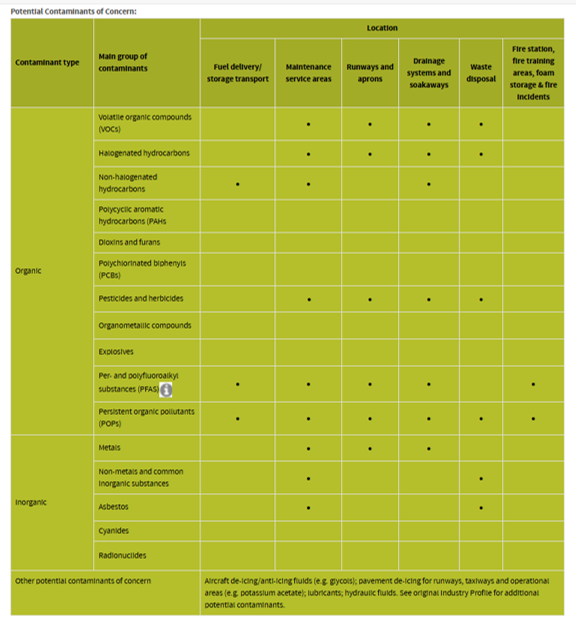
Figure 2: Screenshot of contaminant/location table for Airports profile.
Table 1: Important notes to bear in mind when reading the industry profiles:
| Contaminant groupings
|
The potential contaminants of concern table is divided into (i) organic and inorganic contaminant types and (ii) into contaminant groups taken from the Environment Agency remediation options applicability matrix. It is recognised that there is overlap between some groupings (e.g. VOCs and halogenated/non-halogenated hydrocarbons; PFAS and POPs, and others).
The contaminant groups are the same for all profiles and a black dot is shown for contaminants in that group that might typically be associated with a specific industry. Other contaminant groups (and hence other contaminants) may be present at a particular site. Where there is a blank row (i.e. no black dot), these contaminant groups are not typically found on these sites. To help the user with their understanding, three examples from each contaminant group are provided in a separate table called Example Contaminants. Of course it is essential to consider other contaminants within those groupings.
At the bottom of some of the contaminant tables there is a row for “Other potential contaminants of concern”. This is where examples of contaminants not covered by the generic groups are listed and where readers are directed to the original profiles for a more extensive listing of individual chemicals that may be present. Again this list is not exhaustive.
|
| Locations
|
Most profiles contain several site locations where contaminants are typically found, marked by black dots. Where there is a blank row (i.e. no black dot), these contaminant groups are not typically found at these locations.
Where locations are common to most industrial sites they have not been included in the contaminant tables unless they are considered to have a close association with that site. Common locations and their main contaminant group include: fuel storage areas (non-halogenated hydrocarbons), electrical transformer areas (PCBs) and buildings/building fabric (asbestos).
Some profiles have just a single “site-wide” location (e.g. Waste recycling, treatment & disposal sites) and this reflects the information provided in the original profile and the fact that contaminants are likely to be widespread across these sites rather than in a particular location.
|
Review Process
CL:AIRE reached out to industry via its eAlert, Jiscmail and LinkedIn to seek individual reviewers or relevant organisations that would volunteer to review the profiles. The response was fantastic such that each profile was reviewed by two or three volunteers and then also by the CL:AIRE Technology and Research Group.
The main task of the reviewers related to the assignment of dots to potential contaminants of concern and their likely locations and providing additional information sources.
The potential contaminants of concern were cross-checked with the contaminant tables in CLR8 – Potential Contaminants for the Assessment of Land (Environment Agency, 2002) but these do not assign likely locations. There were also instances where the industry profile and CLR8 did not align and the reviewers were asked to comment on this and provide evidence to support their decision. The steering group were able to weigh up the evidence and have the final say.
Additional sources of information on the potential contaminants associated with these industries were identified by the volunteers and have been listed with links provided where available. These include useful documents like the EC Best Available Techniques Reference Documents (BREFs) and new and forthcoming publications such as the PFAS site profiles. These resources were selected if they are freely accessible documents or webpages (i.e. not behind a paywall) or websites which have multiple free information sources. Links to related industry profiles are provided to either the web page if the profile is one of the 15 updated ones, or to a searchable PDF of the original industry profile. Figure 3 provides an example of the types of further information sources.
The industry review was a key part of the project. If the reviewer gave consent to be mentioned then they have been listed on the acknowledgements page.
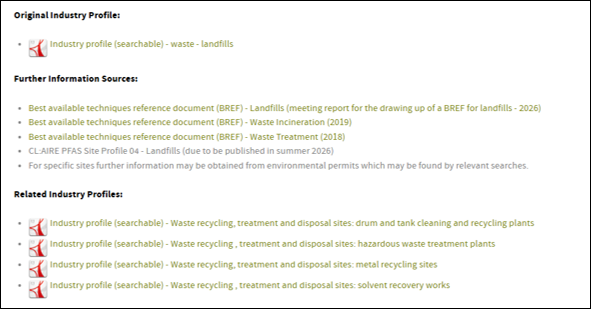
Figure 3: Screenshot of additional information sources for the Waste recycling, treatment and disposal sites: landfills and other waste treatment or waste disposal sites profile.
Feedback and Next Steps
The industry profile project is a live project. General feedback on the information provided is welcome and there is a feedback form to capture comments. This also applies to technical feedback/input. Suggested changes to the assignment of black dots to contaminant groups/locations must be supported by a reference with the recognition that these are “typical” contaminant groups/locations that may not be applicable to all sites. Of course, please also share documents, webpages or websites which are free to access and contain information about contaminant sources and they can be added to this resource.
The next steps are to seek further funding to update the remaining 32 profiles and also to consider developing new profiles covering industries that have had contaminative processes on site that are not covered by current profiles.
As a final note the industry profile pages can be accessed at claire.co.uk/doe
Article provided by Rob Sweeney, Technical Director, CL:AIRE