 Search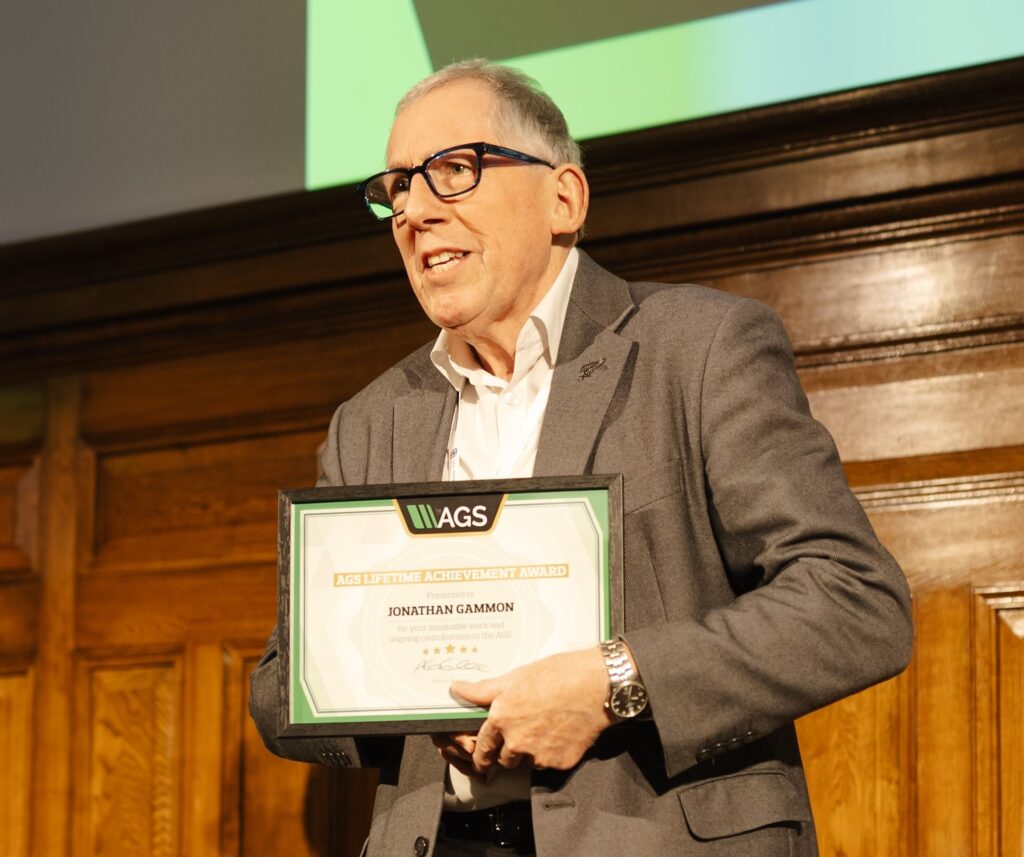
This year, the AGS has presented two lifetime achievement awards. Here, we speak to the second recipient, Jonathan Gammon. Jonathan has been involved with the AGS for over 30 years, serving as Chair of the AGS from 2007-2009, and has taken part in multiple Working Groups over the years including the Senate, Business Practice and the Instrumentation and Monitoring Working Group.
What first inspired you to pursue a career in the geoscience industry?
When I was studying for my degree in Civil Engineering at the University of Surrey in the early 1970s, I fell under the spell of Noel Simons and Bruce Menzies who taught us Soil Mechanics. I had intended to start a career in bridge engineering. During my year in industry, I had worked for contractor Marti AG on the construction of the fantastic Felsenau Bridge in Bern, Switzerland. However, I was easily persuaded to change career direction and had their support to gain a place on the MSc Course in Soil Mechanics at Imperial College and graduated there in 1975, now more than 50 years ago! With further academic study at Imperial under the spell of Professors and Lecturers including Skempton, Bishop, Vaughan (my Tutor/Supervisor), Hutchinson, Chandler, Skinner, Hoek, Knill, De Freitas, and Ambraseys, I was more than adequately inspired to pursue a career in the geoscience industry.
Looking back over your career, which achievement or moment are you most proud of?
If I had to chose just one event it would be receiving my AGS Lifetime Achievement Award at this year’s AGS Annual Conference. That was a total and wonderful surprise. If I was allowed to add others they would include being Chair of AGS, assisting with the establishment of AGS in Hong Kong when working there again from 1996 to 2002, and the opportunities I was given at the University of Surrey and Imperial College, in 2018 and 2019 respectively, to give talks about my career.
Has there been a particular turning point that significantly shaped your professional journey?
Yes. In broad terms it would be turning to live and work overseas after a fantastic foundation to my career as a Graduate and then Chartered Civil Engineer at WS Atkins and Partners, based in Ashtead, Surrey. After working through the Middle East on projects in Algeria, Egypt, Saudi Arabia, and Iran with Atkins, it was time for a move to Hong Kong in 1980. From there we moved to New Zealand in 1984 when, as another proud achievement, I was appointed to set up a Geotechnical Section in one of New Zealand’s largest consultancies, then Murray-North, now AECOM. Being granted New Zealand citizenship was also a proud achievement.
How has the industry evolved since you first started, and what changes stand out most?
The Geotechnical Department at WS Atkins I joined in 1975 comprised of seven members of staff! Now there are several hundred members of staff world-wide. That was a perfect time to join the industry. Consulting Engineers were recognising the increasing need for demonstrable specialist skills as the geotechnical demands of projects increased enormously. Think of offshore production platforms in the ferocious North Sea, for example. Always having a keen interest in my projects, not just the geotechnical aspects, enabled me to support the work of the Civil, Structural, and Transportation Engineering Departments at Atkins as well as engage in exciting work with the Research & Development Team. A step change in the industry occurred in the early 1990s because of the Environmental Protection Act. At that time, the worst recession ever in the construction industry had started to hurt. The need for, and ability to provide, geoenvironmental skills helped the ground engineering community maintain momentum during that tough time. Indeed, the initial name of AGS as the Association of Geotechnical Specialists was expanded in name, but not abbreviation, to become the Association of Geotechnical and Geoenvironmental Specialists. Another important development was the introduction of the Chartered Geologist qualification by the Geological Society of London. For too long, before that, Engineering Geologists had felt their career progress threatened by an inability to secure a professional qualification enjoyed by their colleagues with a Civil Engineering background.
How important have collaboration and professional bodies such as AGS been throughout your career?
Very important. I was fortunate that becoming a Chartered Civil Engineer at the Institution of Civil Engineers at the earliest opportunity enabled me to secure Membership of the Hong Kong Institution of Engineers (HKIE) and what was then the Institution of Professional Engineers New Zealand (IPENZ), now Engineering NZ, when arriving in those countries. Such professional qualifications were vital to securing project work. Establishing AGS in Hong Kong brought me rapidly in contact with those working across the entire ground engineering sector: consultants, contractors, testing laboratories, suppliers, and the like; a situation that would not have been achieved by Membership of HKIE alone. I also enjoy my membership of the British Geotechnical Association, the British Tunnelling Society, and the Railway Civil Engineers Association.
What role has mentoring or supporting the development of others played in your professional life?
I have been fortunate to have worked for and with wonderful senior management and staff throughout my career. There was a magical moment, in my experience, when it was possible to ease back – not entirely! – on personal ambition and to encourage the development of those working for me and to recognise fully their skills and ability, some of which I admit I had not possessed. I am thrilled to find out how members of my teams have progressed in their careers. Some formed their own highly successful consultancies; some now head up major companies. In my early career I received wonderful support from mentors and marvelled at how easy it was to engage in conversation with leading figures in our areas of work. Much as I enjoy seeing the establishment of Early Careers Groups, and the like, I am concerned the these must not become a barrier to conversation across the entire range of ages from students and fresh graduates to those like me, in our seventies, and older.
What advice would you offer to early career professionals entering the industry today?
Fully appreciate the exceptional and unique opportunities that our industry provides to engage with the entire range of types of projects around the entire world. Seize those opportunities when they arise. Accept a job overseas if available. My work in Switzerland provided me with the added benefit of fluency in the German language.
In your view, what skills or qualities are essential for long-term success in this field?
Now retired, I envy those still engaged in work as this is an amazing time to enjoy the benefits that the likes of Artificial Intelligence and ChatGPT bring to the workplace. I am fortunate to have had the mind-set during my career that Computer Aided Draughting (CAD) and Building Information Management (BIM) would prove hugely beneficial to our areas of work, despite the upset and controversy surrounding their introduction to traditional working practice. I admire the work of Bentley, for example, who persevered with CAD all that time ago and now provide us with an ability to gather, interrogate, and make sense of the huge amounts of data that the electronic and wireless world is capable of sourcing and generating, using software such as Leapfrog. I am confident that the inherent skills and qualities that had led someone to start out in our industry will sustain them throughout their careers. In my early years, being a specialist was viewed as career limiting. Thankfully, that proved not to be the case for me and, not without its setbacks, I still reflect on my career with immense joy and a true sense of excitement for the future of our industry and those taking part. Provided one grasps the opportunities to broaden knowledge and experience, to spend time on site, and to keep up with what technology can wonderfully provide, then long-term success should result and be enjoyed.
What does receiving the AGS Lifetime Achievement Award mean to you personally?
I have partly answered this at Question 2., above. I was incredibly grateful to be made an Honorary Member of AGS several years ago. That has enabled me, now fully retired and without a company affiliation, to remain engaged with AGS as a whole and with the Instrumentation and Monitoring Working Group (I&MWG) which I set up in 2019 with the enthusiastic support of then-Chair Julian Lovell. The I&MWG is now very ably led by Tim Clegg. Unexpected as it was, receiving the Award means a huge amount to me personally. It is a lifetime highlight. Thank you to all those involved in providing me with such a special honour.