
Article Safety

Trial Pitting – Still Fit for Purpose?

- by
Tags: Featured

Trial pitting and trial trenching have long been a popular investigation tool within the geotechnical and geo-environmental industry. Trial pits and trial trenches are commonly specified in both geotechnical and geo-environmental investigations and are often a preferred investigative method to enable a rapid check of the condition of the ground. They permit examination of both horizontal and vertical faces exposed as the pit is advanced and also enable the collection of a wide variety of sample sizes and types. Trial pitting and trenching is commonly undertaken using a machine excavator, whether this be a backhoe excavator or a tracked 360 machine. For shallower excavations, or where trenches are required to provide more detailed interpretation of the stratigraphy or underground service identification and mapping, these are often undertaken by hand with or without machine assistance. Vac-Ex technology has also been used by the industry to excavate trial pits and trenches.

Trial pitting is seen as an economically advantageous investigation tool which enables a fair spread of exploratory points to be undertaken within a typical working day. In addition, trial pitting facilitates a wide variety of in-situ tests, for example Hand Shear Vanes, California Bearing Ratio (CBR) tests, Plate Load tests and Infiltration tests in accordance with Building Research Establishment (BRE) Digest 365 Publication (2016).

With a better awareness of health and safety risk within our industry over the past decade or so should we not, however, ask the question whether trial pitting is still fit for purpose and therefore should we strive for an alternative method?

Health & Safety law often uses the term, “so far as is reasonably practicable (SFARP)” forming the basis of any risk-based activity and as such must be used as a decision tool on the risk against the cost and availability of technology to control it.  The HSE, in investigation and prosecution, make a computation in which the quantum of risk is placed on one scale and compared with the sacrifice involved in the measures necessary for averting the risk (whether in money, time or trouble) on the other scale.  The legal test would be that measures which are disproportionate (or grossly disproportionate) would not be SFARP.

All trial pitting activities including site preparation, excavation, sampling, logging and backfilling must be planned and a suitable and sufficient site-specific risk assessment made, contributing then to a method statement. However, consider this: with the Work at Height Regulations (2005), any excavation which has the potential for a person to fall is classed as working from height and, therefore, requires measures to be put in place in accordance with a specified hierarchy (while considering “SFARP”) to comply. Whilst injury can be caused from a fall from any height, a trial pit which is excavated to depths often in excess of 3m can pose a significant risk of injury should an operative fall into the excavation.

Additionally, the Construction Design and Management (CDM) Regulations (2015) were amended and now identify ground investigation as an integral part of the construction activities. Trial pitting as an activity is covered under Regulation 22 (Part 2) which states that Suitable and sufficient steps must be taken to prevent any person, work equipment, or any accumulation of material from falling into any excavation”.

Furthermore, Regulation 22 (Part 1) of the CDM Regulation states that “All practicable steps must be taken to prevent danger to any person, including, where necessary, the provision of supports or battering, to ensure that; no excavation or part of an excavation collapses; no material forming the walls or roof of, or adjacent to, any excavation is dislodged or falls; and no person is buried or trapped in an excavation by material which is dislodged or falls”.

Therefore, all excavations require an assessment to be made of the stability of the excavation prior to commencing the dig and during the dig. These risk assessments should consider factors such as influence of the excavation method, ground conditions, buried services, obstructions, groundwater level, water strikes, contamination etc. An initial risk assessment can be produced to reflect the general approach but inevitably the trial pitting supervisor/logger will need to carry out dynamic, sometimes called “point of work”, risk assessments and where these necessitate or identify significant changes to the risk or methodology it should be documented.

However, as trial pitting work is often undertaken by graduates or technicians, can employers be sure that these individuals possess the required knowledge, training and experience to meet sufficient competency requirements or have the ability to make these assessments and informed decisions?

When detailed logging (i.e. service identification, detailed fabric logging, scan lines or assessment of slip planes) is required, due consideration should be taken to the necessity of entering the trial pit/trench. Where the designer determines that entry is essential, the Contractor must ensure that the excavations are sufficiently shored or the excavation sides battered back or benched to reduce the height of exposed material and potential collapse. Due consideration should also be taken by the Client to allow sufficient time and resources (money) to develop this safe system of work, to carry out any additional training requirements and for the actual work. In addition, these type of trial pits should be located to provide sufficient working room for the plant which will be required for the installation and maintenance of the support system and spoil. As these types of works may be of a longer duration than typical trial pits, physical barriers such as fencing may be required which adds additional costs and time.

When trial pits are part of a more typical ground investigation and require standard logging, in-situ testing and sampling the designer and contractor should consider carefully whether any entry is required whatever the depth. The AGS promotes an approach which does not require entry and therefore, the risk of injury through collapse and subsequent burial is reduced. However, this does not eliminate totally the risk of working at height.

With trial pitting seen as a relatively quick and cost-effective method of ground investigation, the use of edge protection and trench support can be viewed as unrealistically costly and time consuming to install. Compliance with the hierarchy of controls within the Work at Height regulations might suggest to some employers that installation of edge protection or a suitable fall arrest system or other safe system of work, should be mandatory for all excavations. However, the main advantage of trial pitting is to provide a quick and easy way to view the stratigraphy and close up inspection of the pit is necessary to obtain the desired results. Judgements on the required controls under the Work at Height regulations are however to be determined “SFARP”.

The current AGS Guidance on safe excavation of trial pits suggests a number of control measures such as the supervisor/logger should approach and stand at the opposite narrow end of the open pit to the machine, , arisings should be placed a minimum of one metre from the pit edge, and other controls. However, the industry, and associated industries who undertake not dissimilar construction activities, can still not agree on the approach to controlling the risk of working at height when trial pitting or even whether it is a significant risk in the first place.

The principal arguments for the requirement to approach open pits is to observe the formation of the ground and groundwater in situ, accurately measure stratum boundaries, water strikes, final depth and to take photographs. The industry could for example re-evaluate the necessity for photographs and the way they are taken, and whether they are used as anything else but proof the pit was dug. The question could also be asked as to ‘how accurate is accurate’ with respect to depths and is there a safer way to obtain this information. Some excavators can now determine depth of dig whilst excavating and perhaps providing depth markers on the excavator arm may be another alternative.
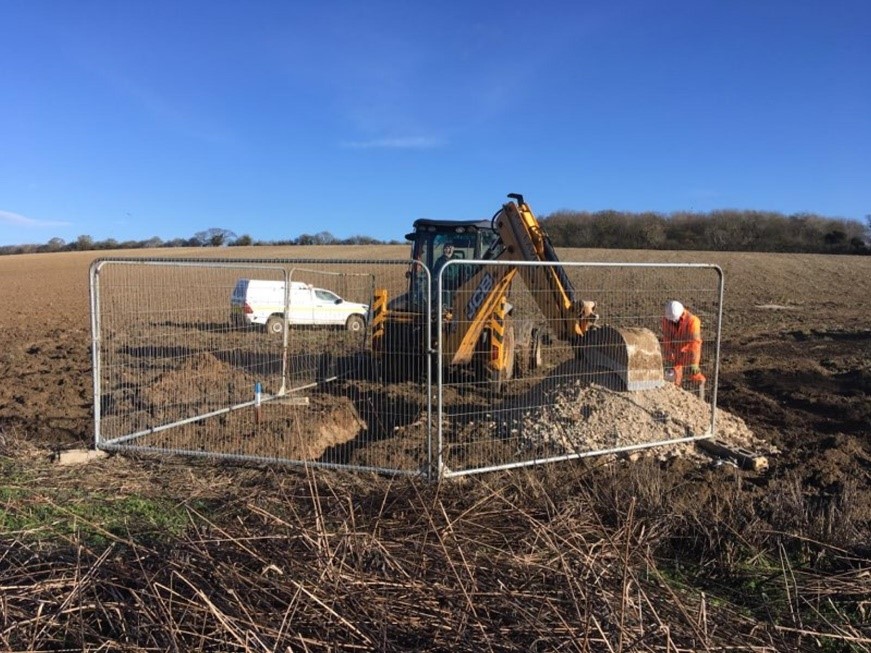
Figure 1 – Typical example of a machine excavated trial pit where the pit is logged from samples only

Employers must also consider the risk of injury from contact with plant and machinery. It is essential that the supervisor maintains good communication (both verbally and using agreed hand signals) with the machine operator at all times. Supervisors should be aware of the danger areas (red and amber zones) around the excavation and always stand in the yellow zone to maintain a clear line of sight.
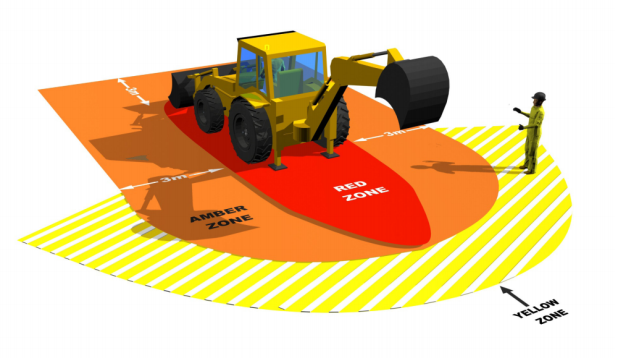
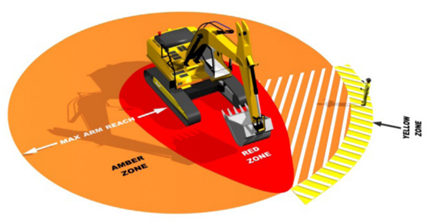
Figure 2 – An example of a safe working zone for mechanical excavation using a 3CX or 360 machine

It is not uncommon that the supervisor (often a graduate and in some cases with limited years of experience) will take on responsibilities for both the H&S and the technical goals of the trial pit investigation. In effect, they take on a role of supervisor, logger and banksman. In the construction industry, banksmen are operatives specifically trained to direct vehicle movement on or around site. How common is it that graduates or even experienced engineers are specifically trained in the role of a Banksman (or vehicle marshal), but are expected to fulfil such a role when directing plant and machinery around site. Therefore, the employer should provide training to allow the individual to carry out this role. This could be delivered through a formal Banksman course or might be better delivered as task specific in-house training which should include all aspects of safe trial pitting to help create competent people who can dynamically risk assess excavations.

But is trial pitting really or inherently a high-risk activity? Excavations are typically left open for only a very limited length of time and are backfilled as soon as the pit is completed in comparison to most construction industry excavations. In addition, there are no clear statistics from the HSE on injuries or fatalities from falls associated with trial pitting. These do occur in the wider construction industry, generally as a consequence of a collapse of the excavation which has been open for some length of time. As an industry we are all aware of the fatality to a Geologist in September 2008, however, statistics of injuries, accidents or near misses are not widely known and are often only communicated internally with site staff and not shared to the wider ground investigation community.

As an industry we must strive to continually improve the safety culture within ground investigation and trial pitting offers us all a chance to either look at current and future innovations to reduce the risk or find safer alternatives. There is a concern that if the industry does not obtain consensus that others may develop approaches which the industry may not find palatable both practically and commercially.

The current AGS document looks to provide practical guidance on trial pitting considering the current H&S guidance available, however, the Designer always has the choice to replace trial pits with boreholes or dynamic sampling holes which would, in many cases, provide similar design data.

The question remains, is trial pitting fit for purpose and the AGS would welcome views from the industry and will be sending out a short questionnaire to determine current industry practice and thoughts.

Article contributed by AGS Safety Working Group

Principal Authors – Adam Latimer, Ian Farmer Associates; Steve Everton, Jacobs and Julian Lovell, Equipe Group



News

AGS Magazine: June/July 2019

- by
Tags: Featured

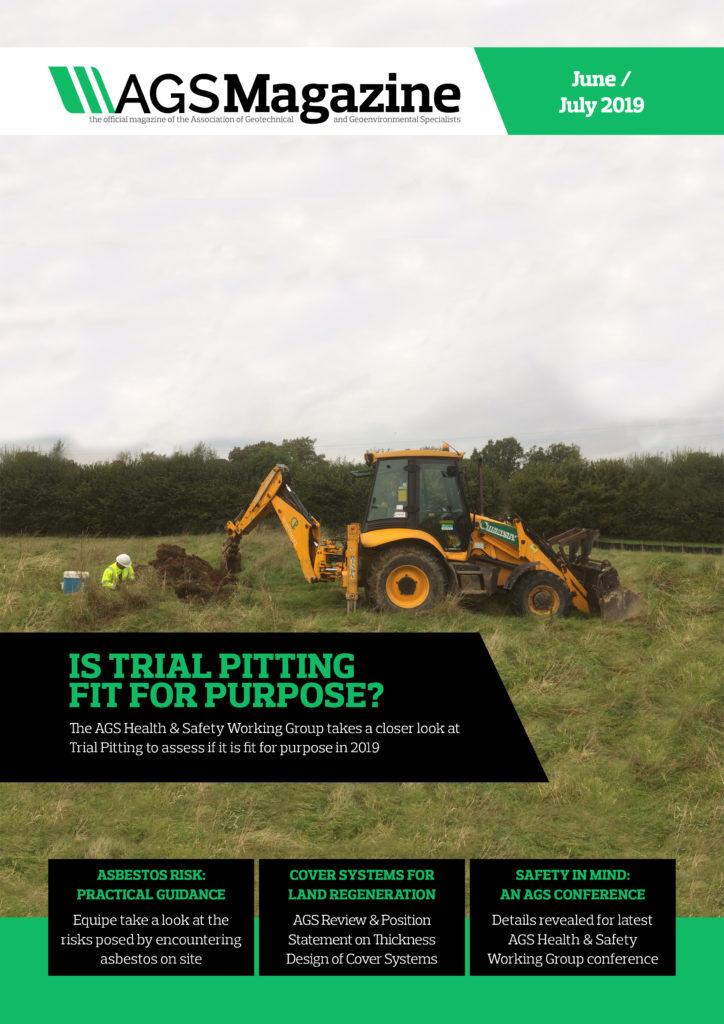
The Association of Geotechnical and Geoenvironmental Specialists are pleased to announce the June/July issue of their publication; AGS Magazine. To view the magazine click HERE.

This free, publication focuses on geotechnics, engineering geology and geoenvironmental engineering as well as the work and achievements of the AGS.

There are a number of excellent articles in this month’s issue including;

Safety in Mind – A conference from the AGS Health & Safety Working Group – Page 8
Trial Pitting – Still Fit for Purpose? – Page 10
Asbestos Risk – The need for practical industry guidance for ground investigation – Page 16
AGS Review and Position Statement: Cover Systems for Land Regeneration – Page 20
Q&A with Geraint Williams of ALS – Page 22
Working Group Focus: Contaminated Land – Page 25
Standards Update: June 2019 – Page 26

Advertising opportunities are available within future issues of the publication. To view rates and opportunities please view our media pack by clicking HERE.

If you have a news story, article, case study or event which you’d like to tell our editorial team about please email ags@ags.org.uk. Articles should act as opinion pieces and not directly advertise a company. Please note that the publication of editorial and advertising content is subject to the discretion of the editorial board.

Article Contaminated Land

AGS Review and Position Statement – Cover Systems for Land Regeneration

- by
Tags: Featured

Thickness Design of Cover Systems for Contaminated Land: BRE/AGS/NHBC: 2004

Starting in 2017, the AGS Contaminated Land Working Group (AGS CLWG) undertook a review of the 2004 BRE/AGS cover systems document to determine:

a) if it was still fit for purpose given current regulatory practice and guidance,
b) what awareness of it there was within the industry and with regulators,
c) how much it was being used and accepted by regulators as evidence,
d) what was current general practice,
e) if the document and software required updating,
f) if it might be applicable or adaptable for sites with trace levels of asbestos.

As part of this review, several questionnaires were forwarded to regulators and private industry practitioners and awareness was raised at several industry events as well as within the various AGS working groups. In conclusion the results of this review can be summarised as follows:

The document is still considered technically fit for purpose, though the fact that it specifically excludes considerations of the emplacement of break layers and water table movements somewhat limits its applicability under current practice at present. That it has not been updated or reviewed since it was published in 2004, and whilst still available is quite expensive, also probably somewhat limits its use by regulators or practitioners.

The document has suffered from a general change in practice since it was first published and perhaps more importantly a change in the way waste is currently defined and perceived in practice during developments. This is (in part) due to regulatory waste changes and interpretations as well as changes in CDM. This is seen as being two-fold in practice, firstly in that the placement of materials from off-site as cover can now potentially be considered a de-facto waste action. Secondly, the technical mixing of potentially contaminated materials in situ with uncontaminated material is contraindicated by current guidance, being seen as potentially “diluting” the contaminants in the underlying materials. This paradox, since the underlying material is probably not technically a waste per se, has certainly in part limited the uptake of this methodology by both practitioners and regulators.

In addition, the responses clearly indicated that many practitioners and regulators were unaware of this document and its potential uses, possibly due to institutional loss of knowledge and experience over time since publication, as well as changes in general contaminated land and waste practice. In addition, it would appear that not many practitioners were presenting such evidence or systems on behalf of clients or developers, probably for essentially the same reasons.

It was noted in the responses that many regulators now default to generic requirements for cover systems. The usual default being 600mm or “Two Spades depth” and usually overlying a break layer. This later element was seen by most regulators and some practitioners as being more effective, acceptable and risk averse in that a break layer provides added security, i.e. by providing an obvious pathway linkage break. Such actions also avoid having to consider potential mixing issues and therefore complies more justifiably with current contaminated land exposure models, remediation practice and guidance by “removing” a pathway rather than just mitigating it.

Unfortunately, this trend may not be truly more sustainable or cost effective as the associated costs and materials used in providing break layers are not always going to be as sustainable as not doing so or accepting lesser depths of cover. Practitioners may therefore logically be taking this lead from the regulators and therefore not considering using the document and methodology on behalf of their clients, even if they are aware of it. This is because the associated costs of justification and arguing the case in a scientific and robust manner may be more than simply accepting emplacement of a break layer and provision of the full cover depth required by the regulator.

On the basis of the above findings, it is considered that current policy and lack of awareness make this a rarely used methodology in current practice. The document and software could be updated relatively easily to make them more user friendly as the general underlying science is still considered current and relevant. However, the general lack of enthusiasm noted for its use in light of the issues highlighted above (especially the general regulatory trend towards the use of generic depths and break layers) probably do not justify the associated costs of doing so at this time.

In conclusion, the basic science is still considered very sound, and the document would benefit from a wider awareness in the community and amongst regulators were it not for the tendency towards the more risk averse inclusion of break layers and standard depths. This has perhaps been a quite reasonable response to changes in regulatory frameworks since the document and software were first produced in 2004 and also probably reflect a general loss of institutional knowledge regarding the methodology over time.

There remains a potential for the methodology to be resurrected and updated for application in solid contaminants such as trace asbestos in soils, though sadly the supporting science is not currently available to justify such works in other than a speculative way.

On this basis the position of the AGS is that updating of this document is probably not sustainable or cost effective at present, but may be so in the future if:
1. Regulatory attitudes change,
2. Practitioners feel it still has utility in certain circumstances,
3. It has greater awareness within the community,
4. It can be adapted to meet additional and scientifically justifiable uses.

Article contributed by AGS Contaminated Land Working Group

Article

Q&A with Geraint Williams

- by
Tags: Featured

Full Name: Geraint Williams
Job Title: Associate
Company: ALS

Geraint has over 20 years’ professional experience and is technical lead for his company. He is a member of the AGS contaminated land and laboratories working group. He serves on the Executive Committee of the Society of Brownfield Risk Assessment (SoBRA) and participates in specialist groups including SoBRA’s vapour intrusion subgroup as well as chairing SoBRA’s Technical Panel. Geraint also serves on EH/4, the British Standards committee on soil quality and is chair of a drafting panel for a new standard on sampling soil for determination of volatile organic compounds.

What or who inspired you to join the geotechnical industry?
My father inspired me to be involved in our industry. I remember travelling to nearby Wirral where he pointed out interesting geological features including the ‘Red Rocks’ at Hoylake.

What does a typical day entail?
I spend lots of time supporting my teams, through technical review, dealing with clients’ challenges and troubleshooting when issues inevitably arise. Training and mentoring colleagues is important and also the most rewarding aspect of my job.

Are there any projects which you’re particularly proud to have been a part of?
I spent the formative years of my career carrying out intrusive investigation work for McAlpine on a major gas pipeline project in the North West which was an excellent grounding for anyone starting out in our industry. I’ve been fortunate enough to be involved in the largest land contamination projects in the UK.

I’ve been involved in projects in the Occupied Palestinian Territories, Afghanistan, Kuwait, Ivory Coast, and Nigeria. I was in Iraq recently training those who are managing the investigation and remediation of sites that experienced widespread destruction from sabotage and looting by Islamic State. The impacts of war in eastern Mosul are so extensive that much of the old city has essentially been destroyed. It is a privilege to be part of reconstruction efforts in conflict affected areas of the world.

What are the most challenging aspects of your role?
Being away from my family – I spent a month in West Africa when my daughter was first born. She is now eight so probably won’t notice if I spent six months away from home!

What AGS Working Group(s) are you a Member of and what are your current focuses?
I’m a member of the Contaminated Land Working Group – we have recently produced practitioner guidance on waste classification for soils, description of anthropogenic materials and environmental sampling.

What do you enjoy most about being an AGS Member?
I genuinely look forward to every meeting as it provides an opportunity to discuss matters that directly affect our industry. It’s a forum for knowledge sharing and promoting best practice. I most enjoy the technical aspects of our meetings and the collaborative way we work together to overcome common issues and challenges.

What do you find beneficial about being an AGS Member?
The AGS is the only organisation representing both the interests of the geotechnical and geoenvironmental sectors. It’s beneficial how different working groups come together to tackle issues – asbestos is a good example of Contaminated Land, Labs and Safety Working groups co-ordinating their efforts to each have input into what will become pragmatic guidance.

Why do you feel the AGS is important to the industry?
AGS provides its members with a real voice within industry – we are active on the National Brownfield Forum, we are represented on the Phase 2 Category 4 Screening Level Project and are involved in updating the Guiding Principles; our membership includes the Environment Agency and the National House Building Council. We probably don’t appreciate how respected and influential the AGS actually is. I suspect this will only increase as focus is shifting more towards industry-led guidance.

What changes would you like to see implemented in the geotechnical industry?
Like most of us, I’d like to see government implement a truly brownfield first policy. Our sector is worth £1 billion a year and employs almost 10,000 people. The housing crisis is one of the UK’s greatest challenges and brownfield development is key to solving it. No surprise that AGS is at the forefront of highlighting these challenges and making positive steps to address them. If you haven’t seen it, read the article ‘Unlocking complex brownfield sites’ in a previous edition of this magazine.

Article Report Contaminated Land

AGS Contaminated Land Working Group Update

- by
Tags: Featured

Vivien Dent of RSK, the leader of the Contaminated Land Working Group, has provided an update on the top issues the Contaminated Land Working Group discussed in their recent meeting which took place in May 2019.

Updating the AGS Asbestos in Ground Investigation Guidance
This document was issued as interim guidance in February 2013. Since this time, there have been several publications and guidance documents published. The guidance is therefore possibly out of date and is being revised. The aim of the guidance is for people to know how to work safely when they encounter asbestos. The AGS Asbestos in Ground Investigation Guidance is currently in final draft and is being peer reviewed by the AGS Contaminated Land WG, along with the AGS Safety WG and AGS Laboratories WG.

AGS Guidelines to Good Practice in Geoenvironmental Ground Investigation
An opinion piece by Chris Swainston of Soils Limited on AGS Guidelines to Ground Practice in Geoenvironmental Ground Investigation was featured in the May 2019 issue of the AGS Magazine and can be viewed on the AGS website. The Contaminated Land WG are considering the possibility of creating a ‘road map’ of documents. The AGS aim to promote good practice – as Chris mentioned in his article – if you stacked the relevant documents on top of each other, the guidance alone would probably reach to your waist. As there is so much information out there – how do you know what is relevant? It is important that AGS members know which guidance to follow and where to find the guidance.

ERES Code Review
A working group has been established to review ERES Codes. The ERES Codes are being reviewed as it is important to have consistent data. For example, so there are not two or more codes for the same determinant.

Next CLWG Meeting
In their next meeting, which is taking place in July, the Contaminated Land Working Group will be looking at the Environment Agency’s online guidance; Land Contamination: Risk Management (LCRM) which is an update to the Model Procedures for the Management of Land Contamination (CLR11), with the aim of providing feedback to the Environment Agency on behalf of the AGS.
Feedback on issues

The Contaminated Land Working Group would like AGS members to feedback to the group about any issues they are struggling with and if there are any issues which they would like to group to investigate. If you do have any issues for the Contaminated Land Working Group to discuss, please email ags@ags.org.uk.