 Search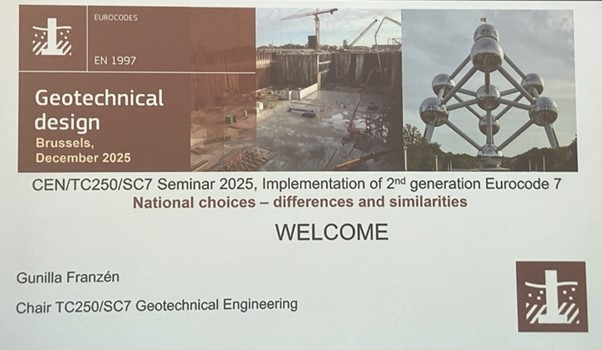
At a CEN/TC250/SC7 meeting in Brussels in mid-December 2025, the implementation of the second generation of Eurocode 7 was discussed. During the opening of the meeting the chair of SC7 congratulated all the countries in Europe that have made the second generation of Eurocode 7 a reality. However, the main reason for the meeting was to discuss the differences (and similarities), between countries in Europe with respect to the implementation of the new code, and to look at what national choices would be made to facilitate the implementation of Eurocode 7 on a country-by-country basis.
In practice this implementation will be achieved using National Annexes that each country will write and use in conjunction with Eurocode 7.
What is a National Annex or NA?
European Normative Eurocodes allow National Standards Bodies (NSBs), to produce a standalone National Annex (or annexes), (NA) which contain national choices and application of informative annexes.
National Annexes are the original national standardization documents that contain information on parameters which are left open in Eurocodes for national choice and known as Nationally Determined Parameters (NDP).
In the UK the British Standards Institution (BSI), is responsible for the publication of standards as well as the UK national annexes. In reality of course the preparation and writing of these documents is done by technical committees under the BSI umbrella.
B/526 is the committee responsible for geotechnics in the UK. This committee which is made up of technical experts drawn from UK contractors, consultants and clients, is split into three sub-committees, with each sub-committee responsible for one of three parts of Eurocode 7. The coverage or remit of these sub-committees is shown in Figure 2.
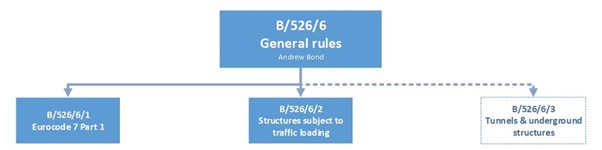
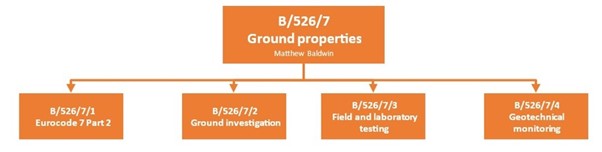
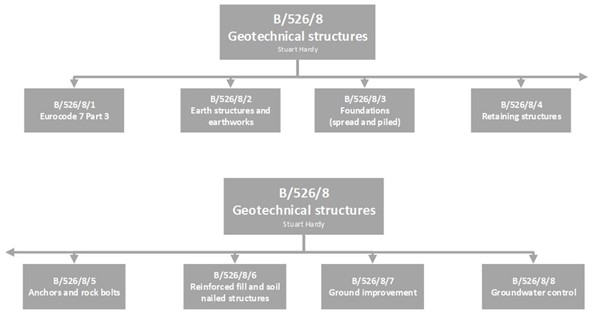
Figure 2: Technical coverage of the BSI B/526 sub-committees
Within the committee structure shown in Figure 2, there exists the technical expertise to help draft the national annexes, that the UK geotechnical industry will use when implementing the second generation of Eurocode 7. These committees and sub-committees circulate their work to industry for public comment and then eventually following industry agreement, the national annexes are finalised and published.
National (Country) differences
The geotechnical design experiences of countries in Europe differ considerably. The mere fact that so many countries were able to agree on a Europe wide geotechnical document in the form of Eurocode 7, is in itself remarkable.
However, each country has different technical, legal and legislative practices when it comes to construction projects. For those countries where the use of documents such as Eurocode 7 are enshrined in law, there needs to be some ‘wriggle room’ to make sure that a single unified document such as EC7, can be made to work in practice. This is where the national annexes fit in.
Without changing the principles or main design equations etc that are laid down in Eurocode 7, individual countries can write a national annex, that allows them to make use of historic practices that are unique to that country.
Over the last few months, the management committee for Eurocode 7, has been drafting questions on key areas of the code. These questions relate to key aspects of each of the three parts, for which it was anticipated that individual countries would want to establish NA’s to accommodate their national practices. Much of the seminar in Brussels was taken up with a review of the national responses to these questions.
The sections within the three parts of Eurocode 7 that required analysis and discussion during the seminar are shown in Figure 3 below.
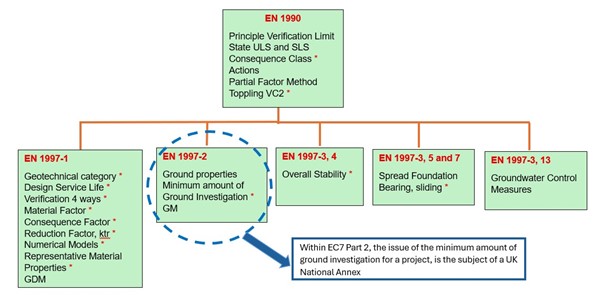
Figure 3: Summary of the sections within Parts 1, 2 and 3 of EC7 requiring discussion
In Figure 3, everything marked with an asterix, needed to be discussed. The discussions ranged from relatively simple topics such as the minimum amount of ground investigation required for a particular design case, to detailed design cases on for example the sliding of spread foundations. Presentations were made by different countries relating to how these different aspects of the code would be dealt with by their country’s geotechnical community.
Whilst it was clear from the presentations that there were distinct differences in approach to the use of the new three-part Eurocode, it was also encouraging to learn that countries were confident that the code could be made to work via the use of national annexes or in some cases via the use of handbooks or guides. The latter two were particularly favoured by those countries in which there was no well-established procedure for making use of a single unique point of reference such as Eurocode 7.
Via a live poll carried out during the discussions, questions were raised about how countries would go about dealing with the prescriptive rules that arise within Eurocode 7. The results of these surveys are shown in Figures 4 and 5.
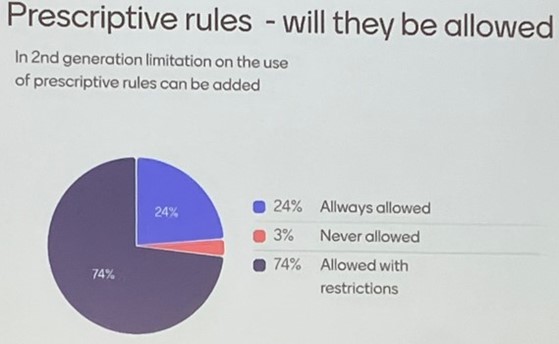
Figure 4: Question on the allowance of Prescriptive Rules on a National Basis
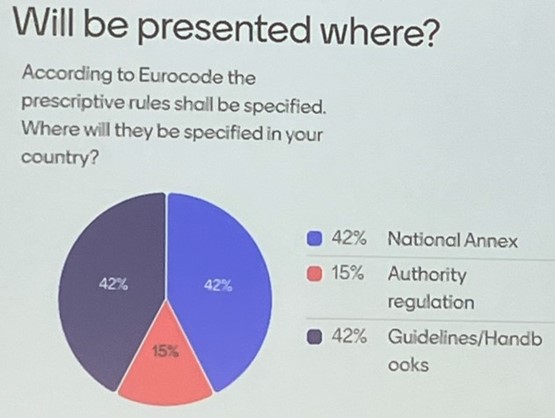
Figure 5: Response from countries as to where Prescriptive Rules will be presented
As can be seen from Figure 4, 98% of those countries that responded said that prescriptive rules would be allowed, albeit in some cases with restrictions. As to where the prescriptive rules would be presented on a national basis, Figure 5 shows an even spilt between those countries like the UK that will use national annexes, and those countries that will make use of more detailed guidelines or handbooks.
Conclusions
Overall, the seminar in Brussels was very positive and national delegates were generally optimistic about making the second generation of Eurocode 7 work for their geotechnical communities.
As noted earlier in this article, it is no mean feat that the European geotechnical community has been able to produce such a comprehensive, but at the same time useable code for use across Europe. The author has been working on the new code for some fifteen years now and will via his role within the geotechnical committee of BSI (B/526), help to ensure ease of use for the new code.
Within the UK, it is anticipated that there will be increased publicity and presentations on the new code to help the UK geotechnical community become fully aware of both the code’s content, but also more importantly how the implementation of the code can be successfully managed and incorporated into the geotechnical design of new structures.
Unlike the first generation of Eurocodes in which the UK was very ‘late to the party’, the second generation has had significant UK technical input form the outset. This has helped to ensure that what we do in the UK in terms of geotechnical design is reflected in the new code.
Article provided by M.J.Baldwin