 Search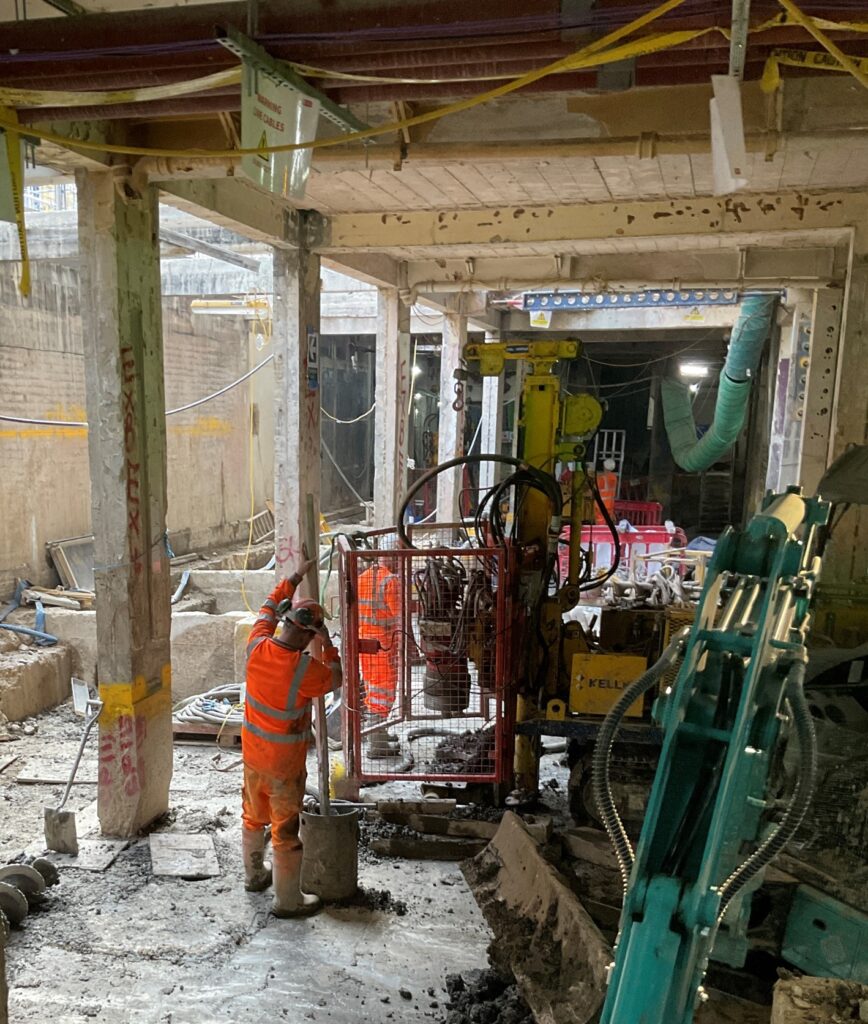
The construction sector is under unprecedented pressure to slash embodied carbon, reduce waste, and deliver projects faster and more economically. One of the most powerful yet still under-used levers is the strategic reuse of existing foundations – both shallow pads and deep piles on redevelopment sites. Instead of treating substructures as single-use consumables, the industry can treat them as long-term underground “assets” capable of supporting multiple building lifecycles. This mindset shift aligns perfectly with circular-economy principles and is rapidly gaining traction with forward-thinking, sustainability conscious clients, planners, and insurers supported by the increasingly innovative construction sector.
Foundation reuse is not a new concept; architects in London were already re-occupying medieval masonry footings after the Great Fire of 1666. What is new is the combination of modern investigative technologies; high-resolution cone penetration testing (CPT), low-strain integrity testing, and distributed fibre-optic monitoring, alongside digital twins that capture historic performance data. These tools give engineers the confidence to quantify residual capacity, model future loading scenarios, and demonstrate compliance with contemporary codes and performance targets. The 2020 IStructE short guide and the ongoing RuFUS (Reuse of Foundations for Urban Sites) research show that with robust desk studies, targeted intrusive checks, and clever load-path design, most urban sites in the right circumstances can achieve partial or complete foundation reuse. [It is essential to assess foundation reuse within the broader context of the entire project, as in less favourable circumstances, reusing existing foundations may introduce constraints that could actually lead to increased carbon emissions elsewhere in the development].
The ability to unlock these gains still hinges on early engagement of geo-professionals. Too often, decisions about demolition and piling are made before a geotechnical engineer is invited to the table, resulting in unnecessary carbon, cost, and risk. Conversely, projects that embed ground specialists from RIBA Stage 0 routinely discover programme savings of several months, substantial reductions in embodied carbon, and enhanced lifecycle resilience. An evidence-based decision hierarchy (including no build options) i.e. reuse, augment, replace, mirrors the waste-reduction pyramid and provides a clear roadmap for clients.
This article explores four key dimensions of foundation reuse. First, the tangible benefits – environmental, financial, and programme-related, available for both shallow and deep foundations. Second, the alignment of reuse strategies with the UN Sustainable Development Goals (SDGs) and the UK’s PAS 2080 standard for carbon management in infrastructure. Third, common pitfalls if geotechnical engineers are not engaged early. Finally, we dedicate a discussion to best-practice guidance on insurance and warranty frameworks (and a brief insight to the Building Safety Act influence) which is an area that often makes or breaks Client appetite and board-level confidence.
By sharing research, project data, and lessons learned, we aim to equip readers with a practical playbook for turning foundation reuse from an exception into standard practice. The prize is compelling: quieter, cleaner construction sites; less congested ground for future generations; and significant cost savings without compromising safety or performance. In short, foundation reuse can, and should, become one of the cornerstones of a genuinely sustainable built environment.
The Benefits of Foundation Reuse
- Environmental dividends
- Carbon and embodied energy: Reusing existing piles or pads eliminates the need for new concrete and steel, slashing embodied energy and CO₂. The RuFUS handbook quantifies reductions in fuel use, plant hours, and concrete volumes when piles are retained instead of replaced, directly lowering whole-life embodied energy and carbon [RuFUS,2006].
- Noise, dust, and air-quality gains: Fewer piling rigs and spoil wagons translate into tangible improvements for neighbouring communities – an increasingly important factor under urban planning frameworks. In addition this translates to less waste including spoil/arisings to landfill.
- Ground congestion: Every new pile you don’t install keeps the subsurface clear for future utilities, basements, and transport corridors, enhancing long-term urban resilience [RuFUS,2006].
- Programme acceleration
- Demolition phase: Avoiding foundation removal and demolition shortens enabling works.
- Construction phase: Re-use can shave weeks or months off the critical path; fewer rigs and less reinforcement curing time speed up superstructure hand-over.
- Earlier revenue: For developers, reduced programme often outweighs pure construction cost savings when net present value is considered.
- Direct cost savings
- Substructure capex: A 2004 case study presented in RuFUS showed investment costs dropping from £3.61 million for complete replacement to £2.38 million for full reuse with limited investigation -a 34 % saving [RuFUS,2006]. Recent developments post 2020 such as City Hall Retrofit and adaptive reuse of commercial buildings tend to show substructure capex savings in the order of 40 – 70% compared to full replacement.
- Reduced muck-away and raw-material procurement create additional OPEX benefits that persist over multiple building life-cycles. A particular advantage where potentially contaminated spoil needs to be disposed of.
- Risk management through data
- Real-time monitoring and load-testing provide empirical confirmation of capacity. Embedding fibre-optic sensors during the initial build adds negligible cost yet provides decades of structural health data, de-risking future reuse scenarios.
- Redundancy and flexible pile-group layouts create built-in contingency, allowing capacity downgrades or local strengthening instead of wholesale replacement [RuFUS,2006].
- Increased data availability through modern data storage and retrieval backed by industry initiatives/requirements such as the CDM Regulations.
- Increased availability of investigation techniques for validation/testing.
- Social licence to operate
- Low-impact methods resonate with neighbouring occupiers, local authorities, and ESG-driven investors. Reusable foundations can become a visible sustainability “badge” in corporate reporting and planning submissions.
- Long-term asset value
- An adaptable underground platform can host multiple generations of superstructures, providing developers with optionality akin to a brownfield land-bank. This enhances the exit value of real-estate portfolios, a point increasingly recognised by institutional investors.
While benefits are abundant, success hinges on robust investigation, detailed foundation assessment backed by engineering judgement where appropriate, and transparent stakeholder communication. These themes feed directly into insurance and warranty discussions explored later.
Linking Foundation Reuse to the UN SDGs and PAS 2080
The United Nations Sustainable Development Goals (SDGs) provide a universal blueprint for prosperity that respects planetary boundaries. Foundation reuse is a concrete way (quite literally) for the built-environment sector to operationalise several SDGs.
- SDG 11 (Sustainable Cities & Communities): Reusing foundations minimises construction disruption, preserves groundspace for future infrastructure, and accelerates urban regeneration, directly improving liveability.
- SDG 12 (Responsible Consumption & Production): By extending asset life and adopting a circular-economy approach, reuse slashes virgin-material demand and associated waste.
- SDG 13 (Climate Action): Embodied carbon reductions from avoiding new piling align squarely with climate-mitigation targets. RuFUS data indicate substantial CO₂ savings when partial or total reuse is adopted [RuFUS, 2006].
- SDG 9 (Industry, Innovation & Infrastructure): Employing state-of-the-art testing and monitoring technologies to validate residual capacity exemplifies innovation in resilient infrastructure.
PAS 2080, the world’s first specification for carbon management in infrastructure, offers a practical framework for turning SDG aspirations into trackable project outcomes. Key PAS 2080 principles echo foundation-reuse practice:
- Carbon hierarchy – “Build nothing, build less, build clever”: Reusing foundations simultaneously addresses “build nothing” and “build less.”
- Whole-life thinking: PAS 2080 stresses lifecycle carbon and cost; foundation reuse embeds residual capacity for future adaption, satisfying both.
- Collaborative value chain: Early involvement of designers, contractors, and insurers is essential to quantify and share carbon benefits; this is exactly the collaboration required for successful reuse.
- Continuous improvement: Data gathered from monitoring reused foundations feed back into better-calibrated design models, reducing uncertainty and driving future carbon reductions.
Quantification remains vital. Lifecycle Assessment (LCA) consistent with EN ISO 14040 series, can be combined with PAS 2080’s “baselining” requirement to produce clear carbon dashboards for clients and regulators. Those dashboards in turn underpin robust ESG reporting and can unlock green-financing incentives.
Policy momentum is accelerating. The UK’s Net Zero Strategy, forthcoming EU taxonomy rules, and many city-level embodied-carbon caps are converging on the need to re-think substructure design life. Specifying 100-year pile lifetimes and designing in redundancy/flexibility enables multiple building cycles without additional piles; this is an approach highlighted in RuFUS as “platform” thinking [RuFUS, 2006].
In essence, foundation reuse is a ready-made vehicle for delivering measurable progress towards SDGs while ticking every PAS 2080 box: lower embodied carbon, reduced capital cost, improved programme, and enhanced asset adaptability. The challenge is not technical feasibility; it is mainstream adoption driven by informed geotechnical leadership, including educating the property owners to curate and retain full substructure as-built and design records even after insurance retention periods.
Best Practice for Insurance and Warranty in Foundation Reuse
Insurance and warranty considerations often determine whether a client embraces or rejects foundation reuse. Perceived risk rather than technical reality can derail reuse proposals both early and more critically late in the design phase. Geo-consultants therefore need a clear playbook to help clients, brokers, and underwriters navigate latent-defect exposure. Influence of the Building Safety Act also need to be considered for foundation reuse.
- Understand the insurer’s worldview
- Underwriters focus on “known unknowns.” Existing piles may hide corrosion, concrete degradation, or undocumented workmanship defects. A structured investigation hierarchy i.e. desk study, non-invasive testing, selective coring, translates these unknowns into quantified probabilities, a prerequisite for any specialist policy.
- Demonstrate redundancy: RuFUS highlights that multiple piles under a cap significantly reduce failure probability compared with single large piles [RuFUS, 2006]. Designing or demonstrating redundancy can lower premiums.
- Select the right cover
- Latent Defects Insurance (LDI): Common in the UK, providing 10–12-year cover for structural elements. LDI can be extended to existing foundations if supported by a condition survey and certification by a suitably qualified engineer.
- Decennial insurance: In civil-law jurisdictions (e.g., France, Qatar), mandatory 10-year coverage can also apply to reused foundations, but only if risk is transparently mitigated and documented.
- Project-specific Professional Indemnity (PI) top-up: Where reuse represents a novel risk profile, consultants may ring-fence additional PI limits for foundation design and certification.
- Navigating the Building Safety Act (BSA) 2022
- The BSA reshapes liability in foundation reuse by extending duty holder responsibilities and broadening the scope of potential claims. On the positive side, the Act encourages more rigorous due diligence, which can strengthen confidence in reuse strategies and support sustainability goals. By requiring clearer accountability and longer limitation periods, it incentivises thorough geotechnical assessment and documentation, helping insurers and warranty providers to price risk more accurately and potentially reducing disputes down the line. With robust geotechnical assessments and clear documentation, reuse can reduce embodied carbon, accelerate programmes, and deliver cost efficiencies.
- However, there are challenges…extended liability windows up to 15 years prospectively and 30 years retrospectively (for buildings completed before June 2022) mean that foundation reuse decision carry long-term exposure. Building Liability Orders (BLO’s) allow courts to extend liability to associated companies if the original company becomes insolvent. The longer limitation periods and broader liability provisions encourage a culture of transparency and thorough recordkeeping. For clients, this means that well-documented reuse strategies are more likely to gain insurer confidence and warranty support. The practical takeaway is to embrace the Act’s requirements as a chance to strengthen project credibility: commission independent verification, maintain digital records that prove compliance, and engage insurers early with clear evidence of safety. Framed this way, foundation reuse becomes a demonstrably safe and insurable one.
- Build a robust documentation trail
- As-built records, load-test data, and monitoring results should be collated into a single digital foundation dossier, ideally aligned with ISO 19650-6:2025 BIM protocols. This requires owners to collate and securely store the full substructure database inclusive of deeds and insurance. Electronic management systems with robust metadata can ensure documents are discoverable via a secure central register. The owner must engage with managing and updating this information, which can be incentivised through selling data from organisational/owner change.
- Certify residual capacity: A formal statement signed by a chartered geotechnical engineer, cross-checked by an independent checker, provides underwriters and funders with confidence.
- Define clear roles and liabilities
- Contractual clarity: Who certifies the foundation? Who monitors performance during the new build? Who holds ongoing liability? Simple, unambiguous scopes avoid grey-area disputes.
- Performance-based specifications: Rather than prescribing methods, define acceptable movement criteria (e.g., settlement < 15 mm) and factor-of-safety thresholds. Allow contractors flexibility to achieve them, while retaining designer oversight.
- Leverage monitoring for post-occupancy assurance
- Embed fibre-optic or vibrating-wire strain gauges to track load redistribution and long-term performance. Streaming data to a secure cloud platform allows insurers real-time visibility, unlocking lower deductibles.
- Trigger-level regimes: Pre-agreed intervention thresholds (e.g., uplift > 2 mm) linked to contingency plans reassure owner-occupiers and tenants.
- Educate the client and the market
- Present comparative risk matrices: Full replacement is not risk-free (e.g., unforeseen obstructions, new pile defects). When quantified objectively, reuse often offers a similar or even lower residual risk at reduced carbon and cost.
- Celebrate precedents: Publishing case studies with transparent performance data grows underwriter confidence sector-wide.
- Cost-benefit framing
- Include avoided-carbon emission shadow pricing and programme gains when comparing insurance premiums. A modest premium uplift may be dwarfed by faster completion and ESG-linked finance incentives.
Conclusion and Next Steps
By integrating investigative due diligence, transparent documentation, smart monitoring and secure data storage, geotechnical consultants can translate technical certainty into insurable certainty. This shifts the conversation from “Why take the risk?” to “Why miss the opportunity?”—unlocking the full sustainability potential of foundation reuse and safeguarding all parties’ financial interests – all while aligning with modern safety expectations in accordance with the BSA 2022. To embed this approach into industry practice, there is a clear need to update and review the RuFUS best practice handbook and to educate Building Control that foundation reuse should be assessed on robust engineering evidence rather than the unwritten ‘10% rule’ for new loading. By reframing reuse decisions in this way, projects can achieve both regulatory confidence and insurer support, ensuring that sustainability gains are recognised as safe, credible, and commercially viable.
References:
Allford Hall Monaghan Morris (2020) White Collar Factory. Available at: https://www.ahmm.co.uk/projects/mixed-use/white-collar-factory/.
British Standards Institution (2020) BS EN ISO 14040:2006+A1:2020 Environmental management – Life cycle assessment – Principles and framework. London: BSI Standards Limited.
British Standards Institution (2023) PAS 2080:2023 Carbon Management in Buildings and Infrastructure – Specification. London: BSI Standards Limited.
Buro Happold et al. (2025) Battersea Power Station – Regeneration of an Icon. Proceedings of the Institution of Civil Engineers – Civil Engineering, 178(1), pp. 23–39. Available at: https://docs.burohappold.com/wp-content/uploads/sites/16/2025/02/jcien.24.00919.pdf.
Communities and Local Government (2006) RuFUS: A Best Practice Handbook – Re-using Foundations in Urban Sites. London: Communities and Local Government Publications.
Ground Engineering (2024) ‘Is the rising tide of foundation reuse in construction a sustainable future?’, Ground Engineering, 1 February. Available at: https://www.geplus.co.uk/opinion/is-the-rising-tide-of-foundation-reuse-in-construction-a-sustainable-future-01-02-2024/.
London Assembly (2024) Retrofit vs Rebuild: Reducing Carbon in the Built Environment. Available at: https://www.london.gov.uk/sites/default/files/2024-02/Retrofit%20vs%20Rebuild%20-%20Reducing%20Carbon%20report.pdf.
London Councils & Arup (2024) A Retrofit Delivery Model for London. Available at: https://www.londoncouncils.gov.uk/sites/default/files/2024-05/retrofit_delivery_plan_for_london_full_report.pdf.
New London Architecture (2025) Adaptive London: Retrofitting the Capital. Available at: https://nla.london/insights/adaptive-london-retrofitting-the-capital.
Pitcher, G. (2022) ‘Pile reuse: Building on past glories’, Ground Engineering, 14 November. Available at: https://www.geplus.co.uk/features/pile-reuse-building-on-past-glories-14-11-2022/.
Tayler, H. (2020) A short guide to reusing foundations. The Structural Engineer, November/December. London: Institution of Structural Engineers. Available at: www.istructe.org/IStructE/media/Public/TSE-Archive/2020/A-short-guide-to-reusing-foundations.pdf.
UK Government (2022) Building Safety Act 2022. London: The Stationery Office. Available at: https://www.legislation.gov.uk/ukpga/2022/30/contents.
Article provided by Jai Shah MEng CEng MICE, Associate, Ramboll
Image provided by Ramboll.