 Search
Name: Luqman Ismail
Job title: Geotechnical Engineering Degree Apprentice
Company: Jacobs
Can you provide an overview on your career history, current role, and responsibilities?
I am currently in the second year of my Civil Engineering Degree Apprenticeship, working within the Tunnelling and Ground Engineering team at Jacobs. My current role involves the writing of geotechnical reports across multiple stages of design such as desk studies, ground investigation reports and geotechnical design reports. I have also been involved in detailed design within highways projects including retaining walls, sign foundations and earthwork repairs.
Alongside this, as part of my apprenticeship I am studying towards a BEng in Civil and Infrastructure Engineering at The University of Warwick. I attend lectures, seminars and practical sessions at the university for one week every month.
What attracted you into the industry?
My passion for the industry stems from my study of A Level Geology. This science has always fascinated me, and studying Geology in sixth form introduced me to the engineering applications of the subject, particularly civil and geotechnical engineering. I researched into the sector and was fortunate to attain this degree apprenticeship program which allows me to kick-start my career, gaining hands-on experience whilst studying towards a funded degree.
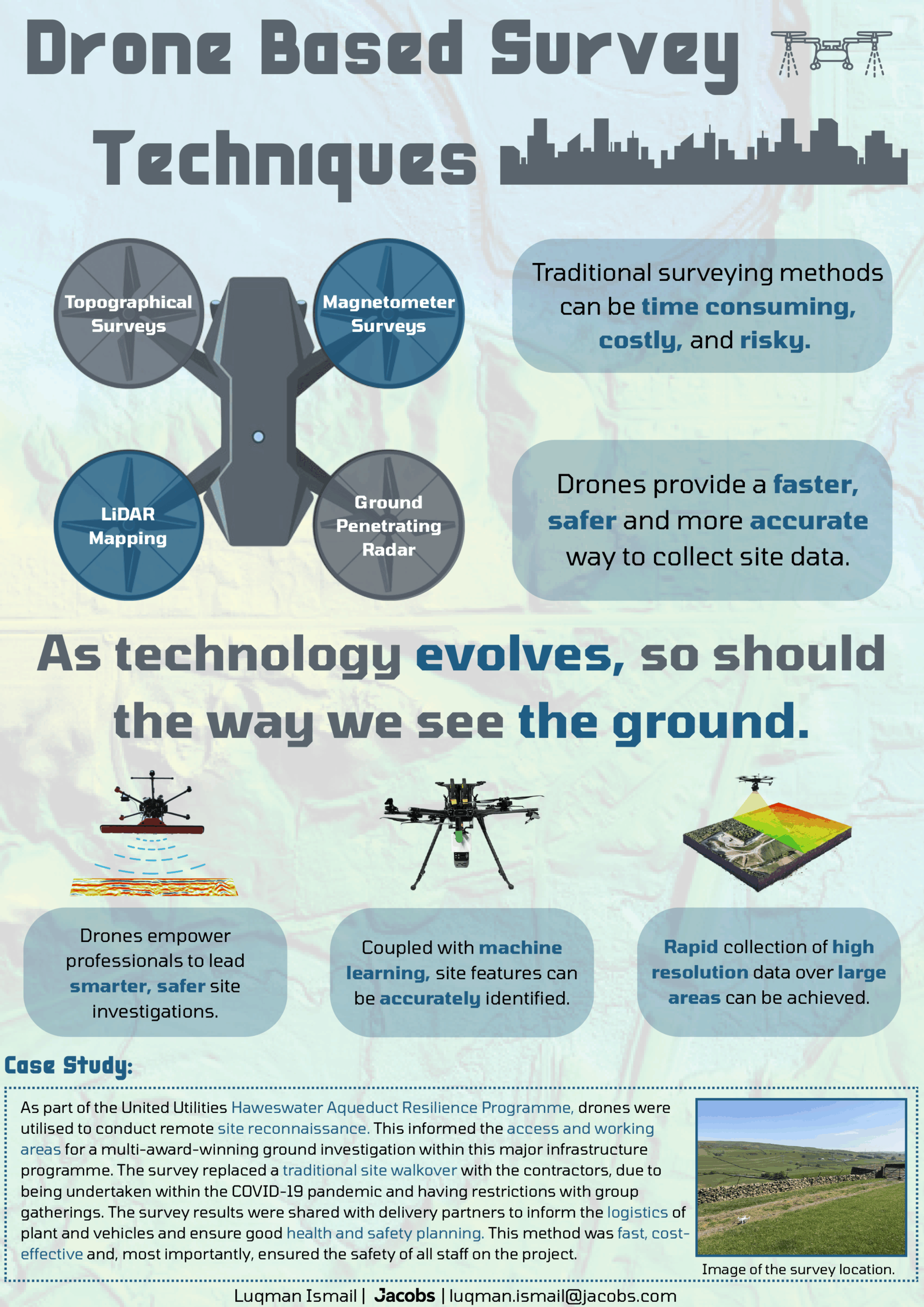
Can you talk us through your poster design? Why did you decide to focus on the use of drone based survey techniques?
Despite not being directly involved with drone-based site investigation, I came across this innovative technique during a lunch and learn at Jacobs, which comprehensively introduced drone-based survey techniques and their scope for the future of site investigation. Inspired by this session, I created my poster showcasing the types of surveys possible and the advantages over traditional survey methods, as well as a case study where drones were used to conduct a remote site reconnaissance.
Apart from your work on drone-based survey techniques, have you been involved with any other innovative technologies within your day-to-day role?
In order to inform preliminary design and desk studies, I have used National Highway’s asset visualisation and information system, which utilises point cloud data and LiDAR to allow for advanced measurement tools in a 3D space. This allows for models and sections to be produced through areas of interest, proving useful for visualisation of sites and key features.
Can you predict an innovation which will dramatically change the geoscience industry in the next decade? Why have you chosen this innovation?
In my opinion, AI has the potential to dramatically change the industry by means of automating data analysis and interpretation, for example, accelerating the creation of detailed geological models. Efficient use of AI will allow real-time monitoring and predictive analysis for ground behaviour, ultimately leading to more efficient site investigation. If utilised correctly, AI can lead to optimised design and construction of infrastructure, ultimately making geotechnical and geoenvironmental practices safer, faster, and more sustainable. As demonstrated in this year’s AGS Conference, there are currently limitations and potential drawbacks of using AI within our profession, however these tools are continuously developing.
How did you find the AGS Annual Conference?
I found the AGS conference very beneficial, everything from the venue to the inspiring speakers was excellent. Being new to the industry meant that I learnt something in every presentation and conversation. It was also great to see my poster on display at the conference, alongside all the other fantastic entries. In particular I enjoyed the presentations on Generative AI in Ground Engineering, and The Expanding Role of Satellite INSAR in Risk Management.
What advice or words of wisdom that would you give someone who is considering entering the industry?
Don’t be afraid to ask questions! As an apprentice entering the industry straight out of school, I’ve found that asking questions isn’t just about clarifying what you don’t understand, it demonstrates a genuine eagerness to learn. It shows your colleagues you’re engaged, thinking critically, and keen to grasp complex concepts, which in turn helps you build a solid foundation of knowledge and understanding much faster.